Common names
Angelfish, White angelfish, Threetailed porgy, Ocean cobbler, Moonfish
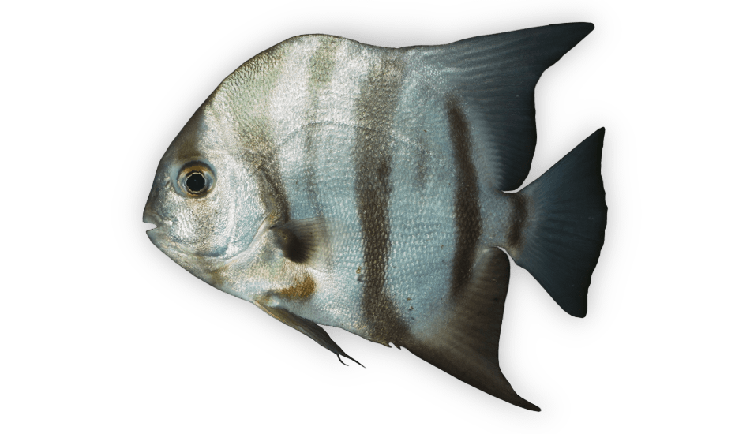
Chaetodipterus faber
Angelfish, White angelfish, Threetailed porgy, Ocean cobbler, Moonfish
The disk-shaped body of this species is deep and compressed, featuring a blunt snout. In adults, the second dorsal and anal fins extend into long, trailing anterior lobes, creating an "angelfish-like" appearance. The body itself is silver, adorned with 4-6 irregular black vertical bands on each side. These bold, blackish bands, starting from the eye and reaching the caudal peduncle, gradually fade with age. Notably, the small mouth of adults has the maxilla ending beneath the nostrils, and the teeth are small and brushlike. There are no teeth on the roof of the mouth. The head and fins are covered with ctenoid scales, adding a textured element to their appearance.
The fish inhabits marine and brackish waters typically in subtropical climates. They are common in shallow waters along coastlines with depths of 3–35 metres (9.8–114.8 ft). Juveniles commonly inhabit estuaries until maturity and adults prefer mangroves, beaches, and harbours.
Western Atlantic: Massachusetts, USA, northern Gulf of Mexico & the Caribbean to Rio Grande do Sul, Brazil.
Atlantic spadefish feed on small, benthic invertebrates including crustaceans, molluscs, annelids, and cnidarians. They also feed on plankton in the water column. Spawning season occurs from May to September. A female can release up to one million eggs per season.
The flesh has a mild flavour and delicate flake without any significant fishy flavour. Spadefish is very similar to Florida Pompano in flavour. The skin is tough and can be removed or cooked skin-side down on the grill to hold in flavor and moisture.
Hooking them is a challenge due to their small mouths. To lure these elusive fish, simply toss a weighted-wire chum basket filled with frozen chopped clams into the water. Veteran anglers suggest that slack tides offer optimal conditions for spadefish biting. The crucial aspect of spadefish fishing is using a small enough hook. The best types of bait to use are jellyfish tentacles or a fly attached to the chum line. Good bait: jellyfish tentacles, chum, cut or live bait, crabs, squid.