Common names
Asian sea bass, Giant perch
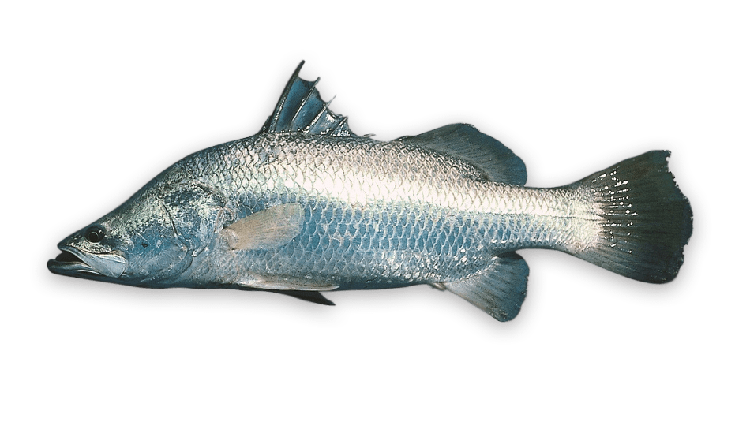
Lates calcarifer
Asian sea bass, Giant perch
Barramundi belong to the sea perch family. They have a distinctly pointed head, elongated body, concave forehead, large jaw which is slightly oblique, the upper jaw extending behind the eyes and a rounded tail fin. They have a dorsal fin with seven or eight strong spines and a second dorsal fin of 10 or 11 rays. They have large, silver scales, which may become darker or lighter, depending on their environments. Freshwater barramundi are greenish-blue on the upper body and have tail fins that are dark brown to black. Saltwater barramundi have a silvery body and yellow fins.
Barramundi are demersal, inhabiting coastal waters, estuaries, lagoons and rivers. They are found in clear to turbid water.
The species is widely distributed in the Indo-West Pacific region from South Asia to Papua New Guinea and Northern Australia.
Barramundi live in both freshwater and saltwater and dominate many tropical rivers. The barramundi feeds on crustaceans, molluscs and smaller fish (including its own species). Juveniles feed on zooplankton. They can consume prey up to 60 percent of their own length.
Barramundi is popular for a reason! The firm white/grey flesh with a large meaty flake is delicious and well-suited to a range of cooking methods. It is robust enough to grill, fry, roast or bake on high heats – these techniques will result in crisp roast skin that is a real treat.
Traditional minnows and soft plastics are good lures to use. Popper lures with a sluggish retrieve can be used at night. Lures like the 4 and 5-inch Paddle Prawn are perfect for barramundi when rigged on a conventional 3/8oz jig head and 3/0 or 5/0 hook. Alternatively, they can be rigged weedless on a worm hook to avoid snagging in heavy timber or weedy areas.