Common names
Southern black bream, Southern bream, Blue-nosed bream
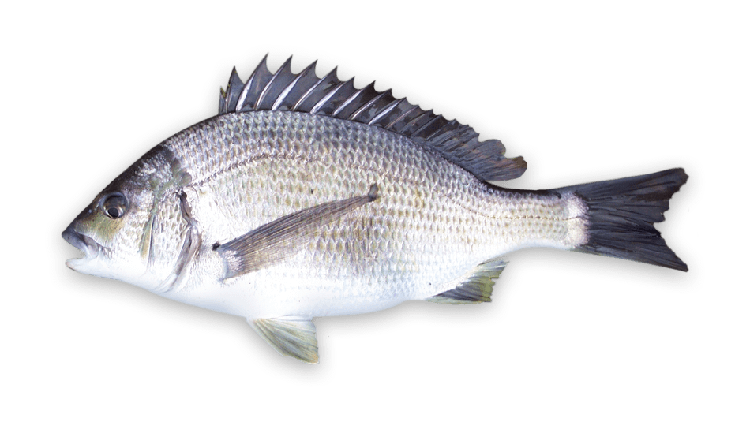
Acanthopagrus butcheri
Southern black bream, Southern bream, Blue-nosed bream
Black bream have a deep, moderately compressed body, with both the dorsal and ventral profiles equally curved. The body is covered with large scales, which may be cycloid or weakly ctenoid in shape. The upper body of the black bream is typically a silvery-olive brown color or bronzy-black, even greenish at times (depending on habitat), while the belly and chin are white. The ventral and anal fins are brownish-black in color, with a small black spot at the base of the pectoral fin.
The species is primarily an inshore species, although has been found on rare occasions on deeper reefs on the continental shelf. Black bream primarily inhabit estuarine environments, penetrating into the far reaches of freshwater creeks and rivers during the summer spawning season. They are also known for a number of coastal lakes and intermittently open estuaries. In estuarine and freshwater environments they seek out the cover of structures such as fallen tree branches, jetties, oyster leases, and rocky areas, while in deeper areas of coastal lakes, they are often found over bare mud and sand substrates. The species is rarely found in the ocean, but are often washed out of creeks during times of high river flow and are able to survive in the marine environment, where they inhabit inshore reefs and rocky shorelines.
The Black Bream's range extends from southern NSW, Victoria, South Australia and into Western Australia as far north as Shark Bay.
Black bream are opportunistic omnivores, consuming a wide range of prey, including sessile, burrowing, benthic and pelagic species. Crustaceans, including crabs, prawns, amphipods and copepods, are commonly taken, as are a number of polychaete and annelid worms. Bivalves such as mussels and cockles are crushed in the bream's powerful jaws, with small fish such as gobies and anchovies also taken.
Bream is a popular fish to serve whole (baked, grilled, steamed or deep fried, often with Asian flavours), as they are plate-sized and the delicate sweet flesh retains its moisture when cooked on the bone.
Bream of all species are quite timid and very sensitive to light and sound. Try keeping unnecessary noise to a minimum. Some of the best live bait items include yabbies, prawns and bloodworms. Even mullet gut proves very effective. Good baits: crustaceans, molluscs, marine worms, small baitfish. Will also respond to small minnow lures and soft plastics.
In southern NSW the Black Bream is often confused with the Yellowfin Bream (A. australis) as their range overlaps. In Western Australia (around Shark Bay) it is often confused with the Pikey Bream (A. berda). The Yellowfin Bream has whitish-yellow ventral and anal fins, as opposed to the Black Bream, which has greyish-brown/black ventral and anal fins. The Yellowfin Bream and the Pikey Bream both lack the characteristic dark spot at the base of the pectoral fin.