Common names
Blackfish, Rock bass, Bluefish, Tallywag, Black seabass
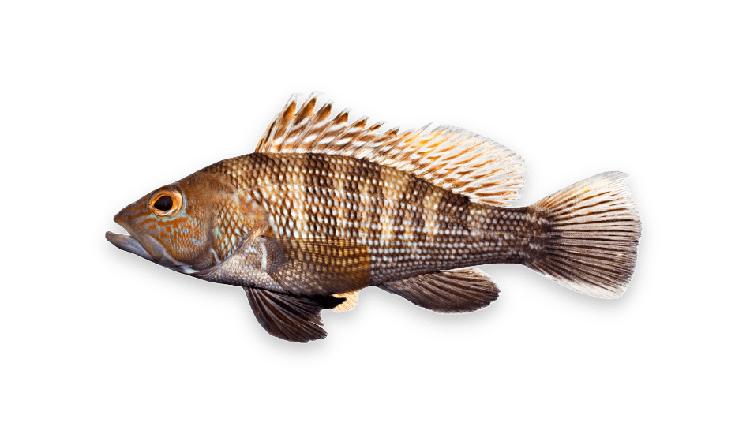
Centropristis striata
Blackfish, Rock bass, Bluefish, Tallywag, Black seabass
Black sea bass are usually black, but smaller ones are more of a dusky brown. The belly is slightly paler than the sides. Fins are dark with dusky spots. The dorsal fin is marked with a series of white spots and bands. During spawning, dominant males turn bright blue and have a blue hump on their heads. Each scale has a pale blue centre, forming horizontal lines across its back and sides. Blue streaks also appear below its eyes. Its large mouth is filled with pointed teeth. Its dorsal fin is striped or spotted with fleshy tips at the end of each spine. Females are paler than males. Juveniles are brownish with a dark, broad lateral stripe.
The black sea bass is commonly found in the vicinity of rock jetties and over rocky substrates in shallow water, although they have also been recorded in deeper, offshore waters.
The black sea bass is found in the western Atlantic Ocean from Nova Scotia south along the eastern coast of North America as far as the Florida Keys and into the Gulf of Mexico as far as Louisiana where the western limit is just to the west of the Mississippi Delta.
Males gather a group of females to mate with and aggressively defend their territory. They are protogynous hermaphrodites, meaning older females become breeding males. They are omnivorous bottom feeders and their diet includes small fish, crustaceans, and shellfish.
This species has lean, white flesh which has a relatively firm texture that breaks into small flakes and has a delicate flavour. The small size of most of the fish available means that they are often cooked whole.
Leadhead jigs or bucktail jigs, which can be tipped with natural bait, soft-plastic trailers, or scented artificial bait (like Berkley Gulp), are one of the best black sea bass baits. Metal jigs also catch black sea bass when fished near the bottom.