Common names
Blacktip whaler, Common blacktip shark, Gray shark, Requiem shark, Small blacktip shark, Spot-fin ground shark
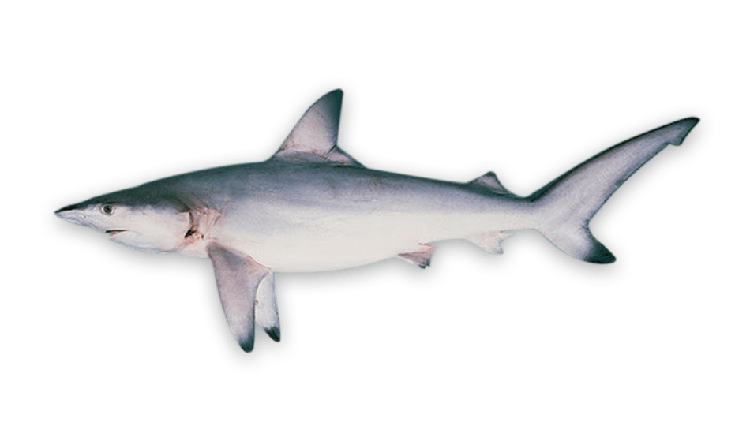
Carcharhinus limbatus
Blacktip whaler, Common blacktip shark, Gray shark, Requiem shark, Small blacktip shark, Spot-fin ground shark
Blacktips are widespread, medium-sized sharks characterized by their black-tipped pectoral, dorsal, and tail fins that give this species its name. It is often mistaken for the spinner shark because both species have torpedo-shaped bodies and are known for spinning out of the water while feeding. They have a dark bluish-gray back (juveniles' back is paler) fading to a whitish belly. The anal fin lacks a black tip (in adults), dorsal fins, pectoral fins, anal fin, and caudal fin lower lobe are black-tipped in juveniles (fades with growth). The first dorsal fin starts above the pectoral fin's inner margin. They have a long snout that appears nearly V-shaped from below.
Favored habitats are muddy bays, island lagoons, and the drop-offs near coral reefs, they are also tolerant of low salinity and enter estuaries and mangrove swamps. Although an individual may be found some distance offshore, blacktip sharks do not inhabit oceanic waters.
Cosmopolitan. Western Atlantic, Eastern Atlantic: Senegal to Democratic Republic of the Congo, Madeira, the Canary Islands, and the Mediterranean. Indo-Pacific: Persian Gulf, Red Sea, Madagascar, and South Africa to China, Australia, Tahiti, Marquesas, and Hawaii. Eastern Pacific: Baja California, Mexico to Peru, including the Galapagos Islands.
Active hunters in midwater. Feed mainly on pelagic and benthic fishes, also small sharks and rays, cephalopods, and crustaceans. Normally wary of humans, blacktip sharks can become aggressive in the presence of food and have been responsible for a number of attacks on people.
Blacktip are among those shark species that are fished for their meat. They have sweet, thick-flaked meat that handles a variety of seasonings and preparations and is excellent on the grill.
With good presentation (Sharks have poor eyesight, therefore you have to put the lure very close to them), they will also hit a variety of artificial lures, especially topwater plugs and flyrod poppers, large (for purposes of visibility) streamer flies. Slow-swimming jigs and underwater plugs. Good baits: oily fish (such as tuna), shrimp, and any sort of fresh-cut bait.
Spinner shark, C. brevipinna (anal fin has a black tip and first dorsal fin starts behind the pectoral fin)