Common names
Blues
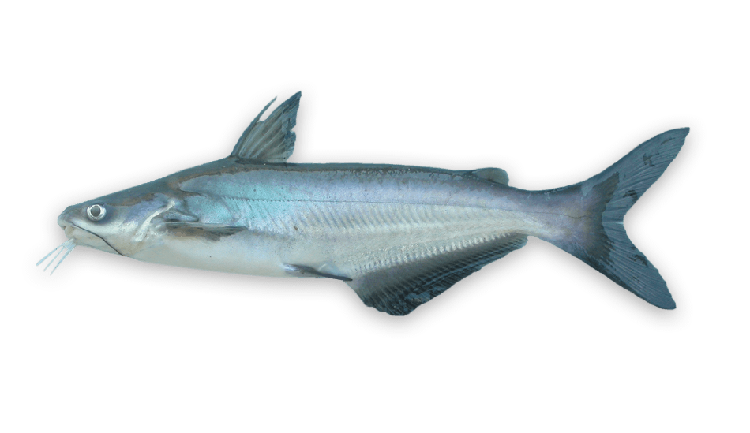
Ictalurus furcatus
Blues
Blue catfish have a flat dorsal fin and a deeply forked tail. Adults have stout bodies with prominently humped backs in front of the dorsal fin. They are silvery-blue in colour with a white belly. Their smooth skin lacks scales. Blue catfish have four pairs of black whisker-like barbels around their mouths and a protruding upper jaw. They resemble channel catfish by having deeply forked tails but lack the spots and have longer straight-edged anal fins. The best way to tell the difference between a channel catfish and a blue catfish is to count the number of rays on the anal fin. A blue catfish has 30–36 rays, whereas a channel catfish has 25–29. The fish is considered an invasive pest in some areas, particularly the Chesapeake Bay.
Blues occur in big rivers and in the lower reaches of major tributaries. They prefer clearer, swifter water than other catfish, and are usually found over sand, gravel or rock bottoms.
The native distribution of blue catfish is primarily in the Mississippi River drainage, including the Missouri, Ohio, Tennessee, and Arkansas Rivers, The Des Moines River in South Central Iowa, and the Rio Grande, and south along the Gulf Coast to Belize and Guatemala.These large catfish have also been introduced in a number of reservoirs and rivers, notably the Santee Cooper lakes of Lake Marion and Lake Moultrie in South Carolina, the James River in Virginia, Powerton Lake in Pekin, Illinois, and Lake Springfield in Springfield, Illinois. This fish is also found in some lakes in Florida.
Young blues eat aquatic insects and small fish while larger blues prefer crayfish, mussels, and other fish. One of the strongest freshwater fish, very determined and always put up a good fight.
They're not only tasty but also quite nutritious. Besides, by consuming blue catfish people are doing something good for the ecosystem (invasive species).
Blues are caught on bush hooks or trotlines as well as rod and reel. Most are caught bottom fishing with cut fish or stink baits rigged on large hooks with heavy lead sinkers. Good bait: Cut herring, mud shad, chicken liver, or menhaden