Common names
Atlantic blue crab, Maryland blue crab, Hard-shells, Peelers, Busters, Soft-shells, Jimmies, Sooks, Sallies, She-crab, Sponges, Sponge crab
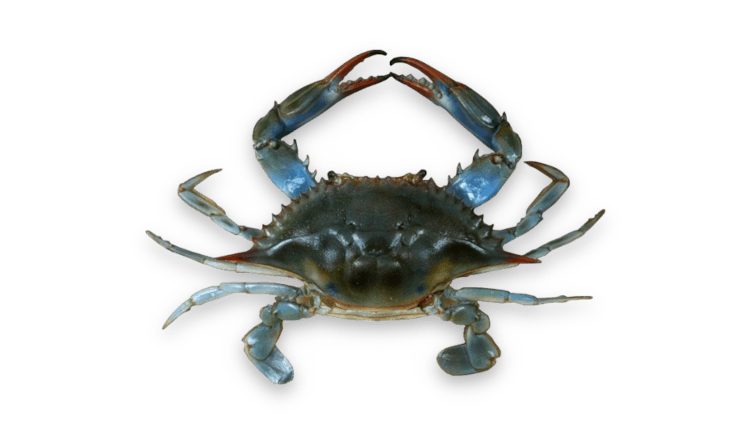
Callinectes sapidus
Atlantic blue crab, Maryland blue crab, Hard-shells, Peelers, Busters, Soft-shells, Jimmies, Sooks, Sallies, She-crab, Sponges, Sponge crab
Blue crabs are characterized by their distinctive "apron," which covers their abdomen. In males, this apron is thin, while in females, it is wider. They possess three pairs of walking legs, along with rear swimming legs resembling paddles. Distinguishing between males and females is relatively straightforward, as males typically have a long and slender abdomen, while females exhibit a wider and more rounded one. Additionally, colour differences in their claws aid in identification. Males sport a blue fixed finger with red tips, whereas females display orange colouration with purple-tipped claws. As females mature, their abdomens undergo noticeable changes, transitioning from a triangular to a rounded shape. The blue tint of the crab's shell results from various pigments, culminating in a greenish-blue hue.
Blue crabs are found on soft bottoms. Habitats include underwater grasses and oyster reefs, and they range from shallow, brackish waters to deeper, saltier waters. Blue crab distribution varies with age, sex, and season.
Tropical to temperate. Western Atlantic: From Nova Scotia to Rio de la Plata, Argentina. Introduced in the eastern Atlantic, North Sea, Mediterranean Sea, Adriatic Sea, Black Sea and Indo-Pacific.
As opportunistic omnivores, blue crabs have a diverse diet consisting of both plants and animals. They feed on various thin-shelled bivalves like clams, mussels, and oysters, along with crustaceans, annelids, small fish, and plant material such as eelgrass. Additionally, they are known to scavenge on carcasses of other blue crab individuals and consume animal waste. The reproductive cycle of blue crabs begins with the hatching of eggs in inlets, coastal waters, and river mouths. The larvae, known as megalopae, are then carried into the ocean by ebb tides. Eventually, they migrate back to estuarine waters, where they mature into adults. However, it's worth noting that blue crabs exhibit high levels of cannibalism, with adult crabs often preying on tethered juveniles.
These types of crabs are known for their sweet and succulent meat, making them a delicacy among seafood enthusiasts. The edible parts of a cooked blue crab include the meat from the claws, legs, and body. Even the yellow mustard inside the crab is edible.
Hoop nets or collapsible traps are inexpensive, but good tools to use if crabbing off a dock or pier. The bait (chicken neck or smelly fish) is set in the middle of the trap and the trap is lowered to the bottom. Alternative simpler methods include hand netting (with a dip net) and hand lining, both methods are best done at night. Good bait: turkey, chicken, mink, fish carcass, shad, herring, clams, etc. (fresh bait works best)
Lesser blue crab, Ornate blue crab