Common names
Eastern Blue Wrasse, Giant Pigfish, Giant Pig-fish, Red Groper, Brown Groper, Eastern Blue Groper
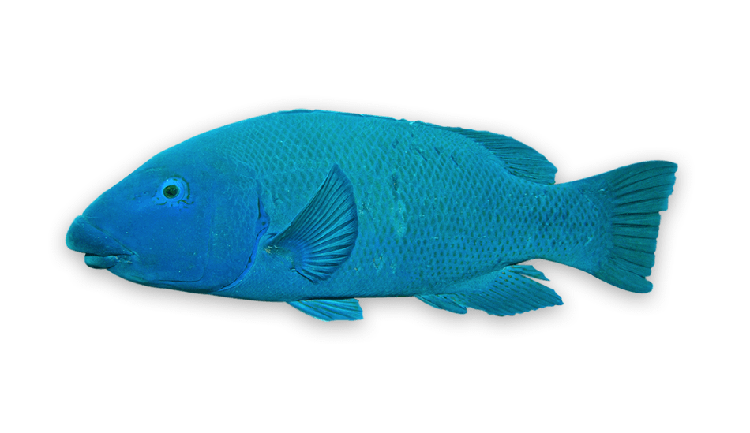
Achoerodus viridis
Eastern Blue Wrasse, Giant Pigfish, Giant Pig-fish, Red Groper, Brown Groper, Eastern Blue Groper
Blue groper have thick bodies, peg teeth, heavy scales, large tails and thick lips. Juveniles are greyish brown, brownish orange or green. Adult females are brown to greenish-yellow. Each scale may have a darker red spot. The adult males have the bright blue colouring that gives the fish their name. The blue can range from deep navy to cobalt blue, and there may also be darker or yellow-orange spots or lines around the eyes. In Australia, certain states like New South Wales have granted protection to this species. In 1998, the eastern blue groper was made the state fish emblem of New South Wales.
The fish live in a variety of coastal waters, especially exposed rocky reefs. Adults are found in a wide range of habitats from shallow waters, down to 40 m. Juveniles are usually found in estuarine seagrass beds.
The blue groper is endemic to Australia. It is found in coastal, marine waters from southern Queensland to Wilson's Promontory, Victoria.
Their diet consists of crabs, prawns, shellfish and sea urchins. They are extremely inquisitive, and while it is now discouraged to feed them by cutting up urchins, they still will approach divers as if expecting to be fed. All blue gropers begin life as females. As they mature, they go through an initial phase, in which they may be male or female, before developing their adult colouring and reaching the terminal phase. Typically you will only find one or two male blue gropers in an area, with a larger number of female gropers in the same area. Should the dominant male blue groper die, the largest female will grow, change colour and sex, and become the dominant male.
Unknown.
Gropers will take all crabs you can find along the rocks. Good baits: red rock crabs (works best), cunjevoi, abalone, sea urchins, octopus/cuttlefish, raw or cooked prawn.
The Blue Groper is a member of the wrasse family and should not be confused with the Queensland gropers (Epinephelus). There is also a similar Blue Groper (Achoerodus gouldii) found in the waters of South Australia and Western Australia.