Common names
Blue crab, Blue manna crab, Flower crab, Bluey, Sandy, Sand crab
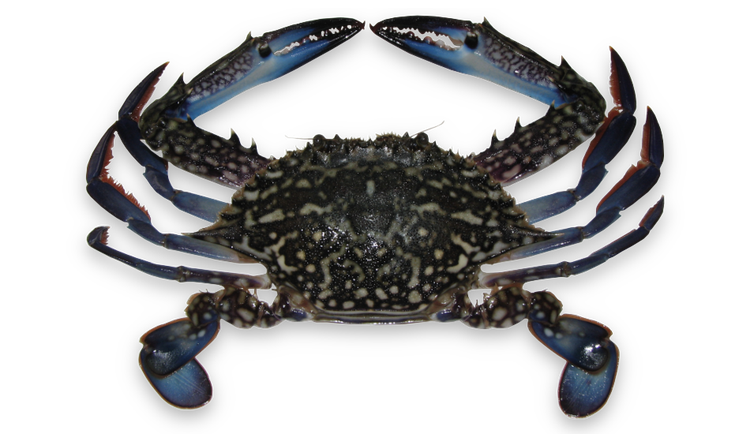
Portunus pelagicus
Blue crab, Blue manna crab, Flower crab, Bluey, Sandy, Sand crab
Males are vibrant blue with white spots and distinctive long chelipeds, while females are duller in green or brown with a more rounded carapace. Crabs from this family are easily identified by their flat, disc-shaped hind legs, which function as paddles, making them excellent swimmers. Their carapace features nine spikes, or horns, on either side of the eyes, adding to their distinctive appearance.
Occur in the deeper waters of intertidal estuaries but occasionally they enter shallower waters.
Found in the West & Indo-Pacific region, including the coasts of Japan, China, Korea, Indonesia, Malaysia, Cambodia, Thailand, the Philippines, and Vietnam. They are also present in intertidal estuaries around most of Australia and as far east as New Caledonia.
They spend most of their time buried under sand or mud, especially during the day and in winter with only their eyes protruding, then launch themselves at prey. They emerge to feed during night or high tide, preying on bivalves, small fish, crustaceans, mollusks, worms, and occasionally algae and seagrass. Unable to survive long periods out of water, they remain dependent on aquatic environments. Larger females primarily spawn in late spring and early summer in the ocean, while estuarine crabs spawn later in the summer, often moving to sea or estuary mouths following winter rains. These crabs enter estuaries as juveniles and grow quite quickly, maturing after one year.
The average yield is 35% (from claws and body). The flesh is translucent when raw and white when cooked, it has a mild, sweet, nutty flavour, low oiliness and is moist, evenly textured and firm (claw meat is firmer than that found in body and legs). Some people enjoy the stronger-tasting ‘mustard’ or brown meat (internal organs) in the body.
There are 2 common methods of catching blue swimmer crabs: You can either catch them by net from land or boat, or they can be caught by raking from the beach. Bait is required for crabbing with a net. The bait attracts crabs to the net and keeps them inside the net before the net is pulled in. No bait is required for raking. Good bait: Flathead Heads, Whiting Heads, Carp & Salted or Brined Pilchards.