Common names
Boar grunt, Golden grunt, Humpback grunt, Yellow grunt, Redmouth grunt
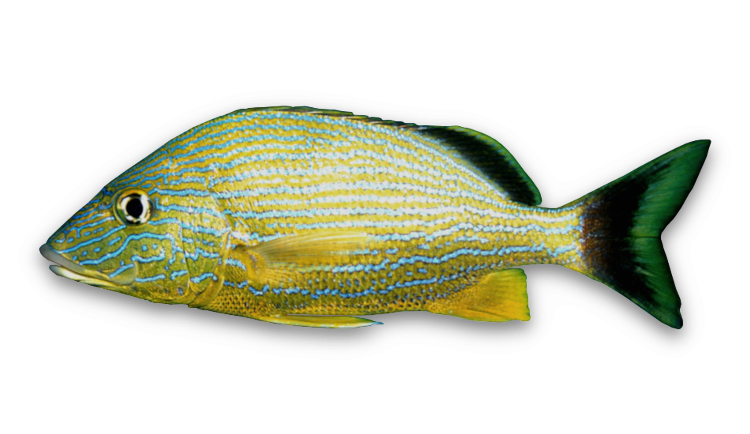
Haemulon sciurus
Boar grunt, Golden grunt, Humpback grunt, Yellow grunt, Redmouth grunt
Bluestriped grunt feature a yellow body and head, adorned with thin, longitudinal blue stripes and a distinct arched stripe below each eye. The spiny portion of the dorsal fin is yellow, while the soft-rayed part and the caudal fin are dark. The anal fin appears sooty yellow, and the pelvic and pectoral fins are whitish. Inside the mouth, the colouration is a vivid red. Juveniles under 22 mm (0.87 in) display melanophores on their caudal peduncles, which eventually develop into a dark stripe extending from just behind the eye to the caudal peduncle. At around 50 mm (2.0 in), the fish transitions to adult colouration. The body is deep and almond-shaped, with a moderately convex dorsal profile. Its upper jaw reaches beneath the center of the eye. The scales above the lateral line are enlarged, while those below are arranged in a diagonal pattern. The species also has a continuous dorsal fin with a small to medium notch at the center. This fish is named for the pig-like grunts produced with their well-developed pharyngeal teeth located in the throat.
They are common in mangroves, reefs, and beds of sea grass. The adults aggregate in small schools over coral and rocky beds, especially in the vicinity of drop-offs. The juveniles are very common among beds of turtle grass (Thalassia testudinum) in shallow waters.
Western Atlantic: Florida, USA to Brazil, including the Gulf of Mexico and the Caribbean Sea.
These fish forage at night in seagrass beds and mangroves, feeding on smaller fish, crustaceans, and bivalves. During the day, they rest in rocky areas. While their spawning behaviour is not well-documented, it is known to occur between January and April in the Caribbean Sea.
Due to their relatively small size they may not yield much meat, and their bones can be a hassle for some, therefore they're not considered good table fare.
Bluestriped grunts can be caught using basic fishing techniques like hook and line, traps, or seines. This species is known for its light biting habits, so it's important to use lead weights that can help keep the bait close to the bottom while allowing the line to run freely.