Common names
Bonnet shark, Shovelhead
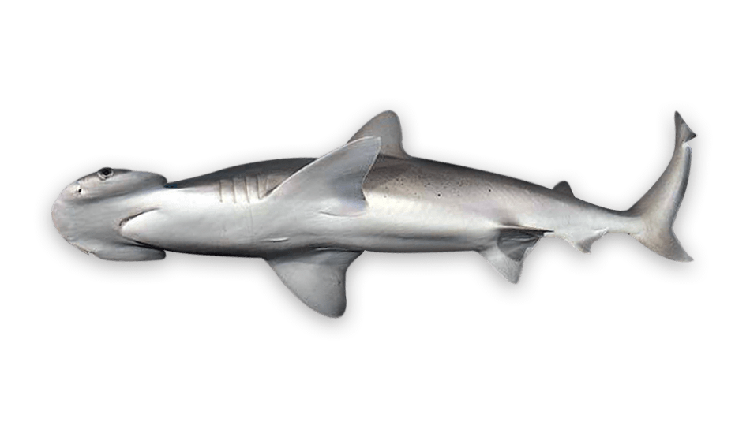
Sphyrna tiburo
Bonnet shark, Shovelhead
Bonnethead shark have a moderately compact body and are distinguished by their compressed, wide, smooth, rounded, shovel or bonnet-shaped heads. Their eyes are located at the ends of the evenly rounded lobes of the flattened head. The front of the head is not notched at the midline. The body is grey-brown above and lighter on the underside. The sides may have small dark spots, there's no inter-dorsal ridge. The upper lobe of the caudal fin is noticeably larger than the lower lobe. Compared to other hammerhead shark species, the pectoral fins of the bonnetheads are larger and more developed in proportion to their body size. This helps them escape from their predators more effectively. The male and the female have distinct physical differences. While the female bonnethead has a rounded, broad head, the male possesses a distinct bulge on the top of its head (a unique feature of the hammerhead species).
It frequents shallow estuaries and bays over seagrass, mud, and sandy bottoms. Moves into deeper coastal waters during the colder months.
In the Atlantic, it ranges from New England, where it is rare, to the Gulf of Mexico and Brazil, and in the Pacific, it ranges from southern California to northern Peru.
These sharks are highly migratory. They feed primarily on crabs, shrimp, mollusks, and small fishes, but are omnivorous. The bonnethead shark is an active tropical shark that swims in small groups of five to 15 individuals, although schools of hundreds or even thousands have been reported. They move constantly following changes in water temperature and to maintain respiration.
Bonnethead shark fillets are thick, flaky, white, and mild in taste. The meat can be dried, eaten fresh, or turned into fishmeal.
Fishing for Bonnethead sharks is similar to chasing smaller game. Simply drop a baited hook in the water or, if you prefer the challenge, catch them on a fly lure. A basic, but fairly tough rod and reel, a minimum 20-pound test line and a circle hook is all you need for Bonnethead shark fishing. Good baits: a fresh piece of chunked blue crab (works best), shrimp, and small fish (anchovies, minnows, scad, etc.).
Other Hammerhead sharks obtain larger size and have hammer-shaped heads.