Common names
Mudfish, Mud pike, Dogfish, Grindle, Swamp trout
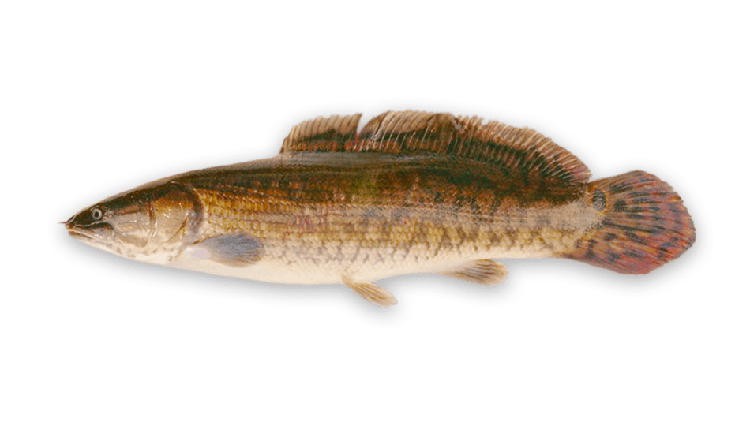
Amia calva
Mudfish, Mud pike, Dogfish, Grindle, Swamp trout
The bowfin is the only living representative of an ancient family of fishes. It has an air bladder that functions like a lung and can be seen gulping air. They have an elongated and cylindrical, stout body, they're olive green in colour with darker mottling along the sides. A large, black oval spot with a yellow-to-orange outline is present on the body at the upper corner of the base of the caudal fin. They have a big mouth with small, sharp teeth, and long dorsal and rounded tail fins. The dorsal fin is long and extends for more than half of the length of the body. Males have a dark spot with a bright orange halo on the tail fin. The spot is absent or inconspicuous in females.
Bowfin prefer vegetated sloughs, lowland rivers and lakes, swamps, backwater areas, and are occasionally found in brackish water. They are well camouflaged, and not easy to spot in slow water with abundant vegetation. They often seek shelter under roots and submerged logs. Oxygen-poor environments can be tolerated because of their ability to breathe air.
Bowfin have a distribution from St. Lawrence and Ottawa rivers and Lake Champlain west throughout the Great Lakes, including Georgian Bay and lakes in Nipissing and Simcoe, Ontario (Canada). They are found south in the Mississippi basin from Lake Winnibigoshish, Minnesota, to Louisiana, in the lower Texas drainages west to Colorado River and along Coastal Plain from Alabama to eastern Pennsylvania (US).
Bowfin are stalking ambush predators that customarily move into the shallows at night to prey on fish, and aquatic invertebrates such as crawfish, mollusks, and aquatic insects. Young bowfin feed mostly on small crustaceans, while adults are mostly piscivorous, but also known to be opportunistic. Males clear a nest among heavy vegetation. Eggs are laid at night and males guard them.
Fair, the flesh is jelly-like but can be prepared smoked, fried as patties or stewed. Bowfin should be kept alive as long as possible before fileting, and then immediately prepared for the table.
Bowfin strike topwater and deep-running lures but are most often caught on live bait. A shiny spinner with bait on the hook is often productive in the murky brackish waters. Good bait: nightcrawlers, minnows, salamanders, frogs, and stinkbait; also good alternatives are crayfish and other crustaceans.