Common names
Eastern brook trout, Speckled trout, Brook charr, Squaretail, Brookie, Mud trout
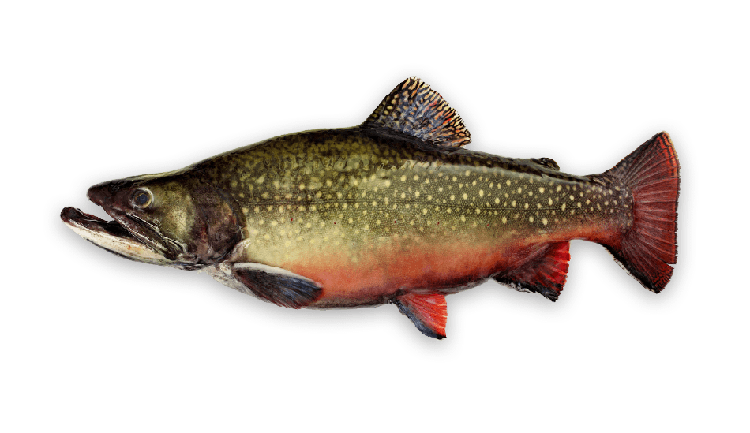
Salvelinus fontinalis
Eastern brook trout, Speckled trout, Brook charr, Squaretail, Brookie, Mud trout
The brook trout has a dark green to brown colour, with a distinctive marbled pattern (called vermiculation) of lighter shades across the flanks and back and extending at least to the dorsal fin, and often to the tail. A distinctive sprinkling of red dots, surrounded by blue halos, occurs along the flanks. Their body is typically wide in the middle and tapers at each end. The belly and lower fins are reddish in colour, the latter with white leading edges followed by a black streak. Its scaleless head has a rounded snout and large mouth. Often, the belly, particularly of the males, becomes very red or orange when the fish are spawning.
The brook trout inhabits large and small lakes, rivers, streams, creeks, and spring ponds. They prefer clear waters of high purity and a narrow pH range and are sensitive to poor oxygenation, pollution, and changes in pH caused by environmental effects such as acid rain.
It is native to Eastern North America in the United States and Canada but has been introduced elsewhere in North America, as well as to Iceland, Europe, and Asia.
Brook trout have a diverse diet that includes larval, pupal, and adult forms of aquatic insects (typically caddisflies, stoneflies, mayflies, and aquatic dipterans), and adult forms of terrestrial insects (typically ants, beetles, grasshoppers, and crickets) that fall into the water, crustaceans, frogs and other amphibians, molluscs, smaller fish, invertebrates, and even small aquatic mammals such as voles.
Their meat is light and delicate and has an almost sweet flavour when compared with the flesh of other trout species. Brookies can be cooked in a lot of different ways, from pan-fried to braised.
For artificial lures, inline spinners and small crankbaits that resemble baitfish work great. A jig with a white curly tail grub or using a small plastic worm works excellent too. Artificial baits in natural colours are always a safe bet. Good baits: yabbies, worms, crickets, very small baitfish.