Common names
Peacock bass
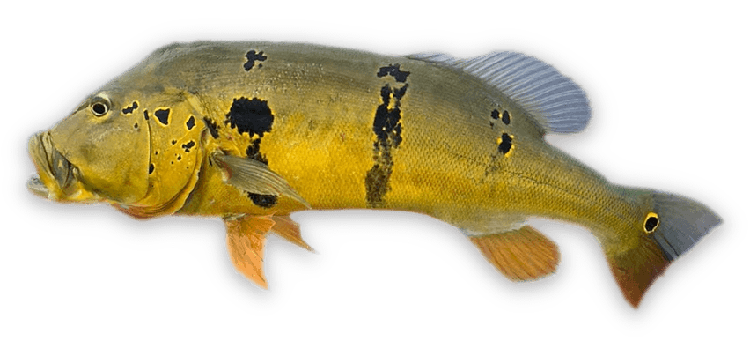
Cichla ocellaris
Peacock bass
Butterfly peacock bass have a body shape similar to that of largemouth bass. Body and fin colours range from yellows, greens, and light red to orange. While colour is extremely variable, the most prominent physical characteristics are the three vertical black lines along the sides of the generally golden body. With the tendency to fade, these lines may not be found on some older fish. The common name of the fish originates from the black spot with a yellow halo surrounding it. This spot is located on the caudal fin and resembles the feathers of a peacock. Males commonly develop a 'nuchal' hump on their foreheads when reproductively active. Peacock bass have been identified as invasive species and cause of ecological imbalances in some of their introduced areas.
Successful in warm, slow-flowing canals, ponds, lakes, deep rock pits, and lateral canals. They're frequently found in murky areas around bridges, culverts, canal intersections, bends, dead ends, and near fallen trees. Spawns and often feeds in shallow water adjacent shorelines with overhanging vegetation.
Native to the Amazon, Orinoco basins, and Guianas rivers in tropical South America. Also introduced in Panama's Gatun Lake and south Florida, Louisiana & Texas, US.
Both adults prepare a flat, hard surface near shore, then lay between 4,000 and 10,000 eggs, young are guarded by both parents, sometimes for several months. Feeding Habits: Feed almost exclusively on fish; tend to use great speed to capture prey, typically feeding only during daylight hours. Peacock bass have helped reduce the number of undesirable exotic fishes, especially spotted tilapia.
Their eating quality is very good. Their flesh is white and sweet when cooked, and has very little oil, making it similar in taste to snapper or grouper. Also, they are not excessively bony.
Use the same basic tackle as largemouth bass anglers, small shiners are the preferred live bait. They rarely take plastic worms, but top-water lures, minnow-imitating crank and jerk baits, and marabou jigs are popular artificial baits. Streamers, epoxy minnows and pencil poppers are favourites of fly fishers.