Common names
King salmon, Quinnat salmon, Tsumen, Spring salmon, Chrome hog, Blackmouth, Tyee salmon
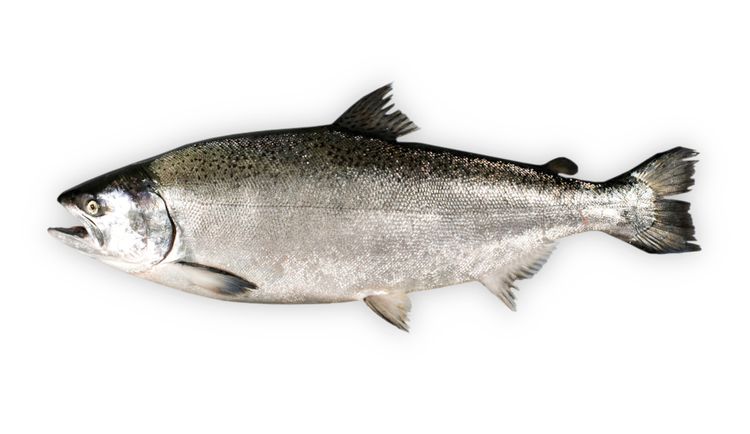
Oncorhynchus tshawytscha
King salmon, Quinnat salmon, Tsumen, Spring salmon, Chrome hog, Blackmouth, Tyee salmon
Chinook salmon have a streamlined body, with a conical head. Snout is rather more pointed than other salmonids (brown trout, rainbow trout). They have small eyes (usually olive to gold in colour), and a slightly oblique mouth extending well back behind the eye in adult fish. The mouth is greatly deformed in ripe adult males, turned up at the tip and unable to be closed. They have well-developed teeth on both jaws, small scales, and broad tail fins with pointed tips. They are predominantly silver, upper body colour is usually bluish-green to olive, with lighter sides and silvery belly, although the entire body can be silvery on a freshly caught fish. At least a few, and sometimes many small black spots on the back, and the top and tail fins. The colouring of both males and females darkens to black on some parts of the body. Readily distinguished from other Victorian salmonids by the dusky grey-black colour inside the mouth alongside the teeth in the lower jaw, thus the nickname "blackmouth".
Clean, cool, oxygenated, sediment-free fresh water is essential for egg development. Riparian vegetation and woody debris help juvenile salmon by providing cover and maintaining low water temperatures. Chinook also need healthy ocean habitats. Juvenile salmon grow in clean, productive estuarine environments and gain the energy for migration. Later, they change physiologically to live in salt water. They rely on eelgrass and seaweeds for camouflage, shelter, and foraging habitat as they make their way to the open ocean. Adult fish need a rich, open ocean habitat to acquire the strength needed to travel back upstream, escape predators, and reproduce before dying.
Chinook are native to the North Pacific Ocean and the river systems of western North America, ranging from California to Alaska, as well as Asian rivers ranging from northern Japan to the Palyavaam River in the Arctic northeast Siberia. They have been introduced to other parts of the world, including New Zealand, thriving in Lake Michigan Great Lakes of North America and Michigan's western rivers, and Patagonia.
They are anadromous fish, juveniles and adults spend most of their life at sea, returning to their natal streams to spawn. Both males and females usually die after spawning. Body condition deteriorates markedly as the spawning time nears. Young Chinook salmon feed on terrestrial and aquatic insects, amphipods, and other crustaceans. Older Chinook primarily feed on other fish.
The flesh of the salmon is highly valued for its dietary nutritional content, which includes high levels of important omega-3 fatty acids
Fishing with back trolling plugs, wrapping plugs, rolling spinners, needlefish jigs, marabou jigs, casting spoons, and bobber fishing with cured salmon eggs are the most popular methods. Good bait: salmon eggs (works best), and sand shrimp.