Common names
Atlantic Thresher, Common Thresher Shark, Fox Shark, Thintail Thresher, Thrasher Shark, Whip-Tailed Shark
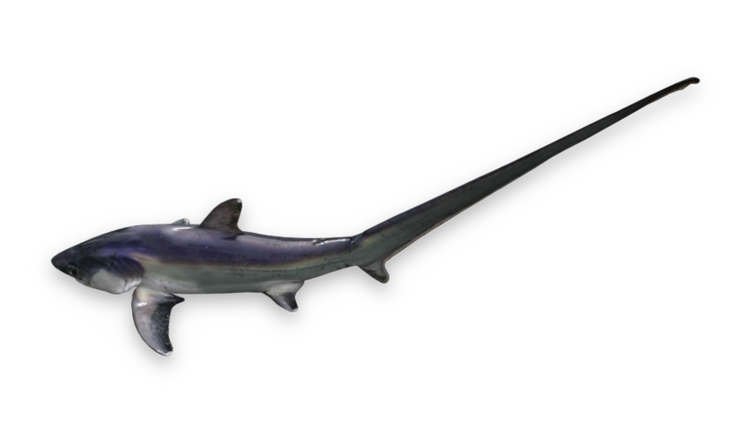
Alopias vulpinus
Atlantic Thresher, Common Thresher Shark, Fox Shark, Thintail Thresher, Thrasher Shark, Whip-Tailed Shark
The common thresher is instantly recognizable thanks to its dramatically elongated upper caudal fin lobe, which accounts for nearly half of its total body length. It has a streamlined, muscular body with a short, pointed snout and moderately sized eyes. Although similar in shape to the pelagic thresher, it can be distinguished by the white coloration on its belly, which extends upward over the bases of the pectoral fins. Its pectoral fins are long, curved, and narrow-tipped, and the lower lobe of the tail, while short, is still well developed. The first dorsal fin is large, while the second dorsal and anal fins are notably small. Coloration varies from brown and grey to deep blue-grey or nearly black on the back, becoming lighter on the sides and abruptly white underneath. White spots may appear on the tips of the pectoral, pelvic, and caudal fins. The shark’s jaws contain small, smooth-edged, curved blade-like teeth suited for gripping prey.
They inhabit both coastal and offshore waters. Adults are typically found in deeper offshore zones, while females migrate into coastal waters to give birth. Juveniles remain in shallower coastal habitats until they grow large enough to move offshore.
This species has a cosmopolitan distribution across temperate and tropical oceans worldwide.
This highly migratory species is famous for its unique hunting technique: threshers use their long, whip-like tails to herd schools of fish toward the surface and then stun them with powerful tail strikes. Their diet includes mackerel, bluefish (tailor), needlefish, squid, and occasionally seabirds. They are also known for spectacular breaches, sometimes leaping completely out of the water. Common threshers possess a specialized circulatory system that helps maintain an elevated body temperature relative to the surrounding water—a trait shared with tunas and billfishes. Despite their size, thresher sharks are shy and generally avoid humans. However, they must be handled with extreme caution when caught due to their sharp teeth and long tails, which can inflict powerful blows.
Thresher shark meat is considered high-quality and is enjoyed cooked, smoked, dried, or salted. It has a mild flavor and a firm, dense, meaty texture. The species is also targeted for its fins, which are used in shark fin soup.
Threshers are powerful game fish often hooked unintentionally on their long upper tail lobe as they attempt to stun live bait. Productive methods include trolling or cast-and-retrieve fishing. When trolling, lures are typically set to depths of 25–50 feet using heavy sinkers. Anglers look for areas where the shark may be hunting and drift at 2–4 knots. Inshore fishing with cast-and-reel setups uses similar principles. Recommended gear includes heavy rods (12–15 weight) around 7.5–8 feet long, paired with 50–80 lb braided line. Due to their relatively small mouths, strong 8/0 hooks with long, durable leaders (8–10 feet of multi-braid) are best to prevent break-offs. Marlin-style lures are commonly effective. Good baits: mackerel, pilchards, herring & sardines.