Common names
Cuban snapper
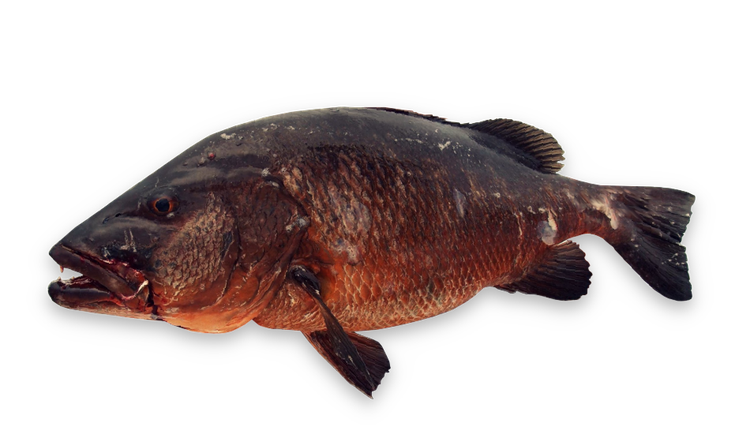
Lutjanus cyanopterus
Cuban snapper
Cubera snapper have a streamlined, oval-shaped, elongated body, which is less deep compared to many other snapper species. They feature a pair of front and rear nostrils that appear as simple holes on their snout. Their relatively large mouth has thick lips and is equipped with canine teeth, including one prominent pair visible when the mouth is closed. The overall colouration ranges from grey to dark brown, with pale to dark grey flanks and, in some individuals, a subtle reddish tint. The caudal fin is light grey, while the pectoral fins can be translucent to pale grey, and the anal, pectoral, and pelvic fins often display a bluish hue. Juveniles may have a faint, indistinct barred pattern on their flanks.
The juveniles shelter within beds of seagrass in in-shore waters or mangroves and have been recorded entering fresh water. The adults move off-shore, where they inhabit rocky ledge and reef habitats.
Western Atlantic: Nova Scotia and Bermuda to the Amazon, Brazil. Rare north of Florida and in the Gulf of Mexico.
They feed mainly on fish, shrimp, crab and lobster using their strong canines. They forage near the bottom or in the vicinity of hard structures. A wary solitary fish, not easily approached underwater. They spawn from May until August when gathering into large spawning aggregations determined by the lunar cycles. They gather in large numbers, up to 10,000 fish over shallow spawning sites in off-shore waters at places such as outer reef slopes and sandy drop-offs
The cubera snapper is considered to be a good-quality food fish, although larger fish in some areas are known to cause ciguatera poisoning. They taste mild and slightly nutty, with a subtle sweetness, have a firm yet finely flaked texture, and are rich in healthy omega-3 fatty acids.
The most effective techniques for catching cubera snapper are bottom bouncing and drift fishing over wrecks and reefs, especially at night. Other successful methods include still fishing, and trolling. While they can be caught year-round, the peak fishing season is from June to September. Anglers are advised to use sturdy tackle, as cubera snapper are known for their strong resistance when hooked. It’s also a good idea to let the fish take some time with the bait before starting to reel them in. Good bait: Lobster (best) & other crustaceans.