Common names
Large-scaled mullet, Squaretail mullet
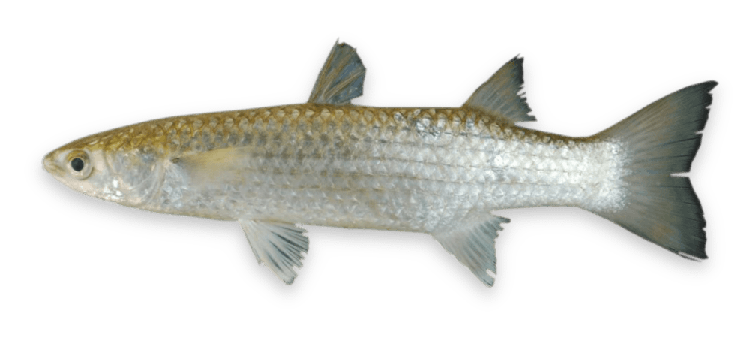
Ellochelon vaigiensis
Large-scaled mullet, Squaretail mullet
The diamondscale mullet is olive-brown on its back with silvery flanks and a white or yellowish belly. It has six longitudinal stripes along its sides which are formed by darker longitudinal markings on the scales which also have darkened edges creating a slightly chequered appearance on the flanks. The iris has yellow patches. The fins have dark margins which contrast with their mainly yellowish cast but the truncate or square caudal fin is obviously yellow, in smaller specimens the pectoral fin is totally black but the lower part becomes yellowish in older fish.
The squaretail mullet can be found in lagoons, estuaries, sheltered sandy shorelines and coastal creeks and can enter freshwater, having been found up to 10 kilometres (6.2 mi) up rivers, although they normally do not move further inland than the influence of the tides. They can form large aggregations among mangroves and the juveniles are frequently recorded in rice paddies and mangroves.
The squaretail mullet occurs from the Red Sea and the coast of East Africa, as far south as Mozambique, eastwards through the Indo-pacific to New Caledonia and the Great Barrier Reef and north to southern Japan.
They feed on phytoplankton, algae and detritus. Spawning is at sea, and the eggs are pelagic and do not adhere to objects.
A strong, distinct taste and moist oily flesh. It can be grilled or pan fried, with the skin crisping beautifully