Common names
Mahi-Mahi, Dolphin, Dorado
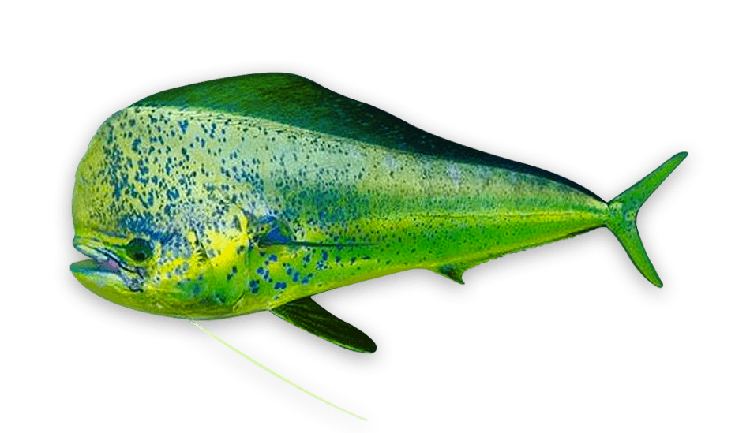
Coryphaena hippurus
Mahi-Mahi, Dolphin, Dorado
Dolphinfish or mahi-mahi have long compressed bodies with bright greenish, turquoise, and blue patterns on their backs, which fade almost immediately upon death and yellow-coloured sides. Its body tapers sharply from head to tail and has irregular blue or golden blotches scattered over the sides. They have a single dark dorsal fin extending from head to tail. Their caudal fins and anal fins are sharply concave. The pectoral fins of the mahi-mahi are iridescent blue. They're capable of flashing purple, chartreuse and a wide range of other colours. The profile of the head of adult males is nearly vertical, on the other hand, the profile of the head of females is more sloping.
Offshore in warm waters. Juveniles live in floating sargassum weed.
The dolphinfish is distributed in tropical and subtropical waters throughout the Atlantic, Indian, and Pacific Oceans. It is abundant in the Gulf of Mexico, the Florida Current, and throughout the Caribbean.
Spawn in warm oceanic currents throughout the year and they don't raise their young (mahi-mahi are among the fastest-growing fish). Diet includes small pelagic fish, juvenile tuna, invertebrates, billfish, jacks, pompano, squid, flying fish and pelagic larvae of nearshore, bottom-living species. They're extremely fast swimmers. When a schooling dolphin is hooked, the rest of the school will often stay nearby.
Excellent. They have firm, flavoursome flesh that make excellent steaks for grilling or BBQ’ing. The meat is also suitable for curries, keeping its shape well and holding up to strong flavours.
Troll natural baits such as ballyhoo rigged on #7 or #8 steel wire with a 7/0 or 8/0 hook. They can also be caught on artificial lures, feathers, or spoons. Chumming cut bait will bring them in and create a frenzy of activity. Good baits: ballyhoo (works best), pilchards, fish strips, squid.
Pompano dolphinfish, C. equiselis (has square-shaped tooth patch on tongue, Dolphinfish have an oval-shaped tooth patch on tongue)