Common names
Dewfish, Freshwater catfish, Jewfish, Tandan
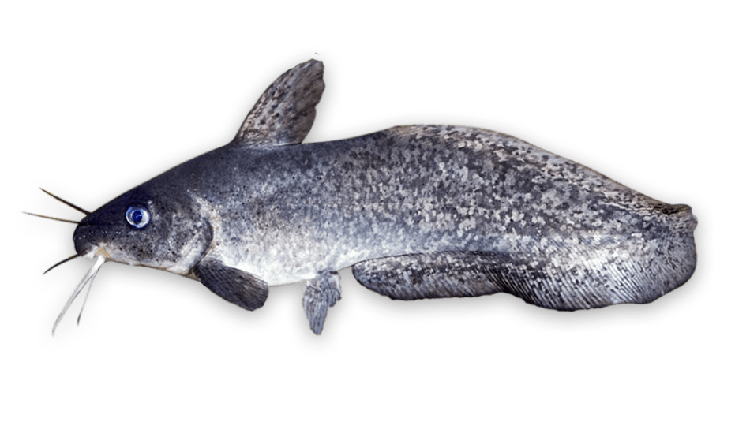
Tandanus tandanus
Dewfish, Freshwater catfish, Jewfish, Tandan
Eel-tailed catfish have large a head with thick and fleshy lips and tubular nostrils. The skin is tough and smooth. Body colouration in adults varies from olive-green to brown, black or purplish on their backs and white on the underside. A downturned mouth with fleshy lips surrounded by a number of barbels assists them with feeding. They are a solid, almost cylindrical, elongated fish, with the posterior half of their body tapering into a pointed eel-like tail. A continuous fin margin surrounds this tapering posterior half of the body. Their eyes are small. The eel-tail catfish has 4 pairs of barbels surrounding the mouth, and sharp serrated dorsal- and pectoral-fin spines which are venomous and can cause a very painful wound.
They inhabit slow-moving streams, lakes and ponds with fringing vegetation. They swim close to the sand or gravel bottoms. This species is more abundant in lakes than in flowing water.
Native to the Murray-Darling river system of eastern Australia.
Though they are usually solitary, juveniles may form aggregations. Juvenile eel-tailed catfish feed on zooplankton, and small insects, particularly chironomid larvae, while adults include shrimp and crayfish in the warmer months and midge larvae in winter. In addition, they eat mollusks and dragonflies, caddis and mayfly larvae.
Considered by some to be the finest freshwater fish of all to eat, eel-tailed catfish have white flesh and an excellent, delicate flavour.
Catfish are usually caught on bait. Be careful when handling the fish, whether for release or not, as the leading edge of the fins has spines that can give you a nasty jab. Good bait: shrimp or scrubworms.