Common names
Emperor snapper, Government bream, King snapper, Queenfish, Red kelp
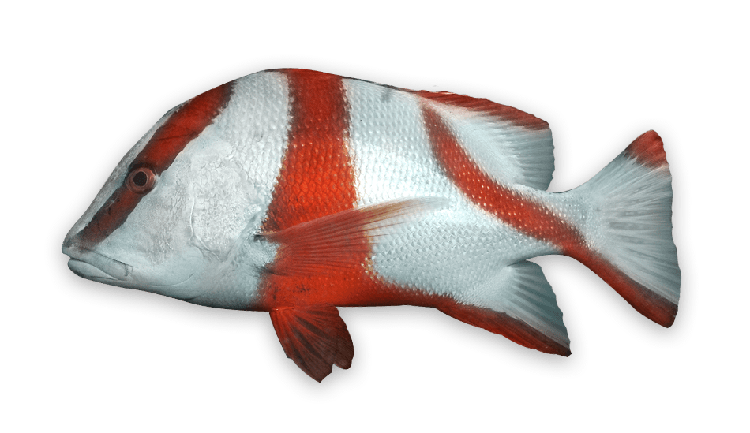
Lutjanus sebae
Emperor snapper, Government bream, King snapper, Queenfish, Red kelp
Emperor red snapper have a very deep body, their standard length being just over twice its depth. The forehead is steeply sloped, the snout has a straight or convex upper profile and the knob and incision on the preopercle are moderately developed. The vomerine teeth are arranged in a crescent-shaped or triangular patch with no rearward extension and there are no teeth on the smooth tongue. The rear of the dorsal and anal fins is very pointed. The pectoral fins contain 17 rays and the caudal fin is weakly forked. Generally red or pink, darker on the back; fins are red except the pectorals which are pink. Juveniles and small adults have a dark red band from the first dorsal spine through the eye to the tip of the snout, a 2nd band from the mid-dorsal fin to the pelvic fin and a 3rd from the base of the last dorsal spine to the caudal peduncle.
This species is an inhabitant of both rocky and coral reefs, preferring flat areas with either a sandy or gravel substrate.
A wide Indo-Pacific distribution from Eastern Africa where it’s range extends from the southern Red Sea to South Africa east into the Pacific Ocean as far as New Caledonia, south to Australia and north to southern Japan. In Australian waters this species can be found from Bunbury, Western Australia around the coast to Sydney.
A predatory fish which feeds on fishes, benthic crustaceans and cephalopods. It aggregates into schools with similar-sized individuals or they will be solitary. This is a slow-growing species, the mean age of first sexual maturity for both males and females was estimated at 9 years old.
Is one of Australia's most highly regarded food fish. Has a mild, slightly sweet flavour, low oiliness and moist, firm flesh with large flakes and few bones, which are easily removed.
Red emperor can be caught on large soft plastics and demersal jigs, but the preference of the experts is fresh, large baits. Good bait: scads, mullet, tuna, pilchard or any other locally caught reef fish.