Common names
Common perch, Redfin perch, Big-scaled redfin, English perch, Euro perch, Eurasian perch, Eurasian river perch, Hatch
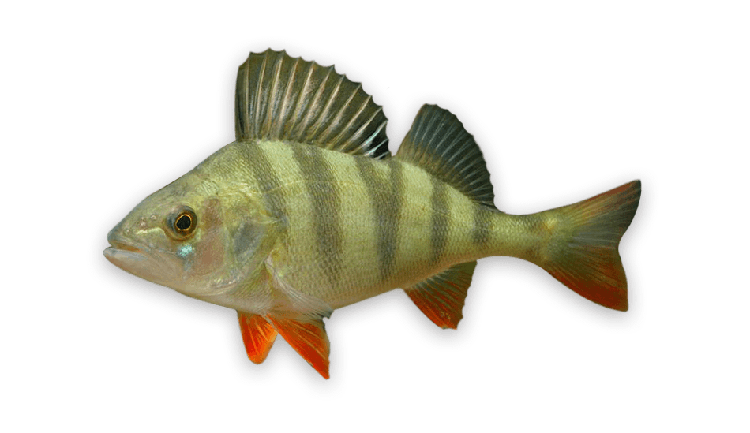
Perca fluviatilis
Common perch, Redfin perch, Big-scaled redfin, English perch, Euro perch, Eurasian perch, Eurasian river perch, Hatch
European perch have five to eight dark vertical bars on their sides. When the perch grow larger, a hump grows between its head and dorsal fin. First dorsal fin has 14 strong spines. Posterior edge of gill cover very sharp. Scales characteristically rather large and firmly attached to skin. Rough to the feel. European perch can vary greatly in size and colour between bodies of water. Specimens from clear waters are olive green on the back and the sides have dark vertical bars. Underside pale. Pelvic, anal and caudal fins orange-red. Eye yellowish. Colouring darker in peaty waters, with back almost black and bars less prominent. Underside then also slightly darkish. The fins of such fish may be strongly red in colour.
The European perch lives in slow-flowing rivers, lakes and ponds. It tends to avoid cold or fast-flowing waters but some specimens penetrate waters of these type, although they do not breed in this habitat. They are most abundant in relatively shallow lakes and lakes with deep light penetration.
The range of the European perch covers fresh water basins all over Europe, excluding the Iberian peninsula. Their range is known to reach the Kolyma River in Siberia to the east. Is also common in some of the brackish waters of the Baltic Sea. The species has been widely introduced beyond its native area (with reported adverse ecological impact after introduction), into Australia, New Zealand and South Africa. They have caused substantial damage to native fish populations in Australia and have been proclaimed a noxious species in New South Wales.
The perch is a predatory species. Juveniles feed on zooplankton, bottom invertebrate fauna and other perch fry, while adults feed on both invertebrates and fish, mainly sticklebacks, perch, roach and minnows. In the Northern Hemisphere they spawn between February and July, depositing their eggs on water plants or the branches of trees or shrubs immersed in the water.
Their flesh is described as good eating, with a white, firm, flaky texture and well flavoured.
Trolling or casting small diving hard-bodies or “Tassie Devil” style lures is an effective technique. They also respond to artificial “Powerbait” style products. Good bait: worms, earthworms, maggots, mudeyes, dead baits (minnows) and casters.