IUCN Vulnerability status
is considered to be threatened with global extinction
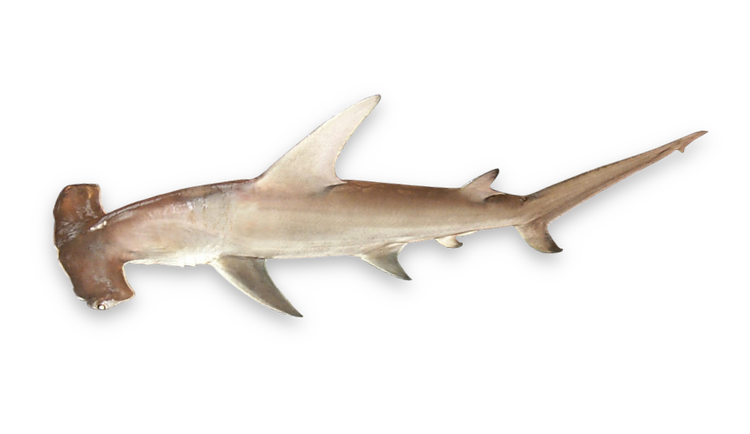
Sphyrna mokarran
is considered to be threatened with global extinction
Great hammerheads are large sharks with a pale grey to bronzy-grey body that transitions to white on its underside. The head's front margin is nearly straight in adults, with a slight notch in the center. Its first dorsal fin is tall, curved, and pointed, while the second dorsal and pelvic fins are also tall with deeply concave rear edges. The teeth are heavily serrated. This species is easily identified by its unique "hammer" or cephalofoil, which has a broad, nearly straight front margin, and its tall, sickle-shaped first dorsal fin, setting it apart from other hammerhead species.
Found close inshore and well offshore, over the continental shelves, island terraces, and in passes and lagoons. Often bottom and reef-associated.
Circumglobal in coastal warm temperate and tropical seas. Western Atlantic: North Carolina, USA to Uruguay, including the Gulf of Mexico and the Caribbean. Eastern Atlantic: Mediterranean and Morocco to Senegal. Indo-Pacific: throughout the Indian Ocean; Ryukyu Islands to New Caledonia and French Polynesia. Eastern Pacific: southern Baja California, Mexico to Peru.
They are highly migratory, solitary predators often avoided by other reef sharks. If threatened, they may display aggression by dropping their pectoral fins and swimming stiffly or in a jerky manner. They feed on a variety of prey, including bony and cartilaginous fishes, cephalopods, and crustaceans, with a preference for bottom-dwelling species like stingrays, groupers, and sea catfishes. It also preys on crabs, squid, other sharks, rays, and lobsters. Interestingly, great hammerheads often swim on their sides, periodically rolling from side to side—a technique believed to reduce drag and save energy.
Its large fins, including the tail, and sail-like first dorsal fin, are prized in the Oriental sharkfin trade for shark fin soup. Humans consume fresh, dried salted, fresh-frozen, and smoked meat that is taken from other parts of the shark. However, consumers should be aware that large specimens may have high levels of mercury and other pollutants.
To target great hammerhead sharks, anglers often begin by chumming at around 15 feet deep using oily fish like anchovies, sardines, pilchard, or flatfish, either while trolling or at anchor. Use a #8 or #10 circle hook with a small weight for the chum bait. Reeling in these powerful sharks requires heavy-duty tackle, such as 400-500 yards of 50-80 lb test line. Effective fishing techniques include bait casting, drift fishing, still fishing, trolling, and surf casting. Good bait: squid & oily cut bait.
Scalloped hammerhead shark