Common names
White Shark, White Death, White Pointer, Great White
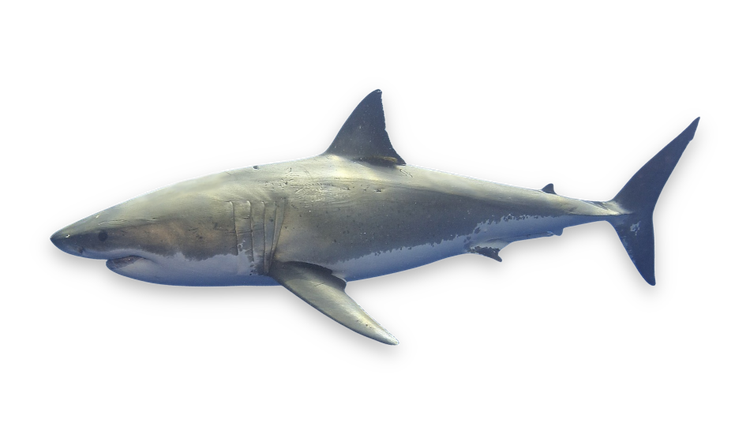
Carcharodon carcharias
White Shark, White Death, White Pointer, Great White
The great white shark is a massive, spindle-shaped predator with a blunt, conical snout and large, triangular, saw-edged teeth. Its eyes are conspicuously black, and the powerful crescent-shaped tail is built for speed. The first dorsal fin typically begins above the inner margin of the pectoral fins. Coloration is lead-grey to brown or nearly black on the back, fading to lighter sides and an abruptly white underside, with a sharp contrast between dark and light pigmentation. A small black spot is often visible at the rear base of the pectoral fins. Great whites possess around 300 serrated teeth that are continuously replaced throughout their lives. Their enormous, oil-rich liver can make up more than a quarter of their body weight, providing both buoyancy and energy reserves.
This species has one of the widest habitat ranges of any fish. Great white sharks occur in coastal and offshore waters, over continental and island shelves, and occasionally around remote oceanic islands. They tolerate temperatures from approximately 5°C to 25°C and are often found close to shore, including surf zones, shallow bays, and estuaries.
Worldwide in temperate and subtropical oceans.
Great white sharks are pelagic and capable of long-distance migrations across entire ocean basins. They are usually solitary or found in pairs, but may form temporary feeding aggregations of ten or more individuals when food is abundant. They are apex predators with an exceptionally broad diet that includes bony fish, sharks, rays, seals, sea lions, dolphins, porpoises, sea birds, squid, octopus, crabs, turtles, and carrion, including dead whales. Juveniles feed mainly on mid-water and bottom-dwelling fishes, while adults target larger, calorie-rich prey such as pinnipeds. Great whites are partially warm-blooded, allowing them to remain active and hunt efficiently in colder waters. Attacks on humans are rare but do occur, most often in coastal or estuarine environments where mistaken identity can happen.
Historically, great white shark meat was considered edible and mildly sweet with a firm texture, sometimes compared to lobster or crab. However, harvesting is not considered worthwhile due to the difficulty, ethical concerns, and strict legal protections. Shark meat can contain toxins that are reduced through cooking, and high mercury levels make it unsuitable for pregnant women and young children. Today, great white sharks are protected in many regions and should not be harvested.
Targeting great white sharks is highly regulated, unethical, and generally impractical for recreational anglers. Where legal and permitted, fishing methods may include trolling or drifting large oily fish baits such as tuna, snapper, or mullet through a chum slick using extremely heavy offshore tackle and steel leaders. Only specialised shark release rigs should be used, and the shark must be released immediately without being removed from the water. Great whites are highly sensitive to prolonged fights and hooking trauma, and many do not survive capture even when released.