Common names
Allied kingfish, Great amberfish, Greater yellowtail, Jenny lind, Sea donkey, Purplish amberjack, Reef donkey, Rock salmon, Sailors choice, Yellowtail, Yellow trevally
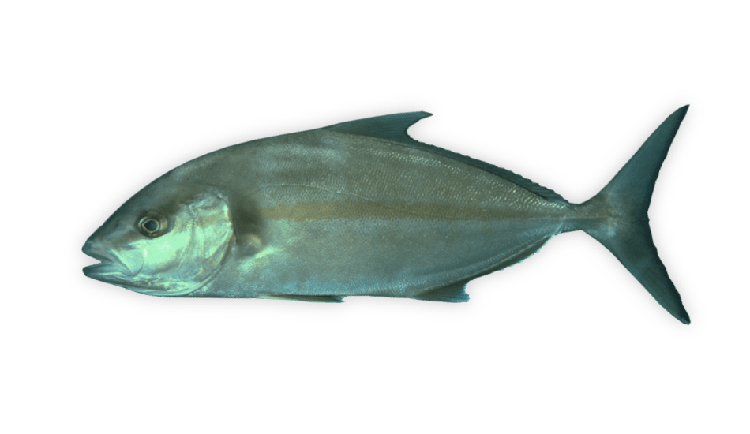
Seriola dumerili
Allied kingfish, Great amberfish, Greater yellowtail, Jenny lind, Sea donkey, Purplish amberjack, Reef donkey, Rock salmon, Sailors choice, Yellowtail, Yellow trevally
Greater amberjack have a dark amber strip on their head, extending from their nose to their first dorsal (back) fin, which becomes more defined when the fish is excited or feeding. They have a brownish or bluish-grey back, a silvery-white belly, and an amber horizontal strip along the middle of their body. Juveniles have a yellow colour and five or six dark vertical bars along the sides. The shape of the body is elongated and fusiform and it is of moderate depth and laterally compressed, and has a covering of small semicircle scales. The fins are dusky in colour. The second dorsal and anal fins have a low anterior lobe.
Greater amberjack are found in the vicinity of reefs, deep offshore caves, drop-offs, rocky outcrops, and deep seaward reefs. They sometimes enter coastal bays, while the juveniles are infrequently recorded quite far well out to sea where they shelter among floating algae and debris.
The greater amberjack has an almost circumglobal distribution in the world's subtropical and tropical seas and oceans. In the Indian Ocean, it is found along the African coast from South Africa east through the Persian Gulf to Western Australia and southern Japan, reaching the Hawaiian Islands and Micronesia in the Pacific Ocean. It reaches as far south as the island of Tasmania off the coast of Australia. In the western Atlantic Ocean, this species is found around Bermuda and on the North American coast as far north as Nova Scotia extending south as far as Brazil, including the Gulf of Mexico and the Caribbean Sea. In the eastern Atlantic Ocean, it has been recorded as a vagrant as far north as the British Isles and is found off in the Bay of Biscay south to Morocco and in the Mediterranean Sea.
Largest of the jacks, as natural predators and extremely aggressive fish. Thought to spawn offshore throughout most of the year. Feed on squid, fish, and crustaceans.
As long as the right parts of this fish are cooked and there are no parasites, it is totally edible and quite good. Greater amberjack has a rich, buttery flavour. Just make sure that the tail is checked for parasites and that it is properly cleaned and cut.
Bottom bouncing, saltwater jigging and drift fishing (works best) are favourite methods for catching Greater amberjacks. Other effective methods are also trolling & casting. Greater amberjacks are not known to be very picky eaters, they will respond to jigs, spoons and plugs. Good bait: cigar minnows, sardines, mullets, blue runners, and menhaden.
Guinean