Common names
Australian smooth hound, Eastern spotted gummy shark, Flake, Smooth dog-shark, Sweet william, Whitespotted gummy shark, White-spotted gummy shark
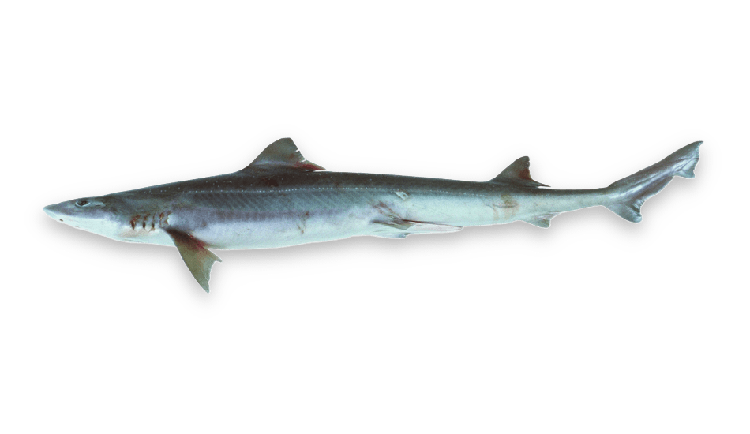
Mustelus antarcticus
Australian smooth hound, Eastern spotted gummy shark, Flake, Smooth dog-shark, Sweet william, Whitespotted gummy shark, White-spotted gummy shark
Gummy sharks are slender with short, flat, and broad heads, especially in females which are larger than males. They exhibit a grey or grey-brown hue on their upper body and a pristine white underside, featuring white spots on the back and upper sides. A distinguishing feature is their second dorsal fin, nearly equivalent in size to the first dorsal fin. Their mouth is short and angular, housing multiple rows of blunt, flattened teeth. The name "gummy shark" stems from their flat, plate-like teeth, used for crushing both shelled and non-shelled prey. Displayed measurements are taken from the rear-most gill slit to the base of the tail fin.
The Gummy Shark inhabits estuaries, coastal and continental slope waters.
Endemic to eastern and southern Australia from off Hinchinbrook Island, to Geraldton, Western Australia, including Tasmania.
They feed on crustaceans, marine worms, small fish, and cephalopods such as octopus, squid and cuttlefish. It uses its plate-like teeth to help it crush the shells and bodies of its prey for easier consumption. The gummy shark remains on or near the sea beds, and their travel patterns vary on age. Juvenile gummy sharks will travel less than full-grown species. Females tend to travel longer ranges compared to males. They will come closer to shores during the night in search of prey.
Gummy sharks have sweet and delicious flesh and are popular for their boneless and thick flakes. They are commonly used for the traditional “fish and chips” but should not be overlooked for barbecuing, poaching, braising and baking.
Use a medium-to-heavy rod with an 8-15 kg line. Attach a 1.5m heavy leader with one or two 6/0 hooks. Use an appropriate sinker to keep the bait at the bottom. Gummy sharks are best caught at night, especially during a rising tide, but can also be caught during the day. Good bait: large oily strip and chunk baits (trevally, mackerel, salmon, pilchards), strips of squid, eel, mullet, garfish, etc.
Starspotted smooth-hound, Spotted estuary smooth-hound