Common names
Jaguar cichlid, Managuense cichlid, Managua cichlid, Guapote tigre, Aztec cichlid, Spotted guapote
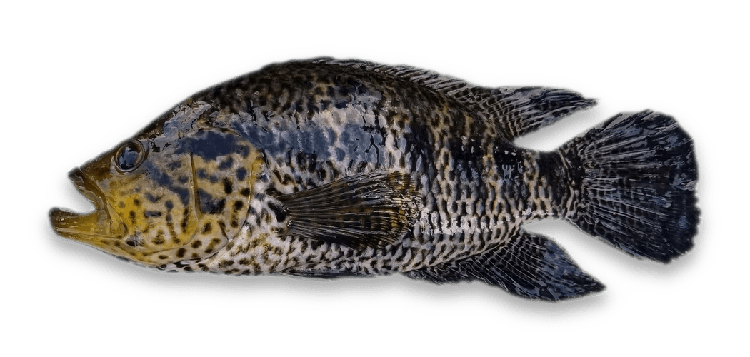
Parachromis managuensis
Jaguar cichlid, Managuense cichlid, Managua cichlid, Guapote tigre, Aztec cichlid, Spotted guapote
Jaguar guapote are members of the cichlid and tilapia family. They have a semi-elongate and compressed body, and a large oblique mouth. This species has a slightly concave dorsal head profile. The head is often yellow to olive-green, the sides have purple iridescence, the back is moss green and the belly is whitish or yellowish. They have got a broken lateral line and the black-and-white patterning makes this species distinct. Their mouth is toothed and protrusible and they have numerous purple to black spots or blotches on their body and fins with a series of black squares along their sides. Males are typically larger than females. Distinguished from other members of the genus by having the preopercle expanded at the angle. The only local species that might be confused with the jaguar guapote is the black crappie, but guapote's teeth and broken lateral line instantly set it apart.
Found in box-cut canals, tolerant of poor water quality. In their native range, they occupy a variety of habitats including rivers and lakes with muddy, sandy, and rocky bottoms.
The Atlantic slope from the Ulua River (Honduras) to the Matina River (Costa Rica), also found in the southeastern United States.
Most spawning occurs from March through July, with a secondary peak in October-November. Both parents are protective of eggs and young. They are medium-sized opportunistic predators. They feed primarily on small fish (including many exotic species) and aquatic insects, they also consume some snails, worms, and even an occasional lizard.
Excellent tasting meat.
Fish on light tackle, they are usually caught on beetle spins, spinnerbaits, rubber jigs, flies and other small artificial lures that imitate small fish. Good bait: live worms and small fish.