Common names
Buffalo Bream, Mountain Trout, Rock Flagtail, Dusky-finned bulleye, Rockmountain bass, Spotted flagtail
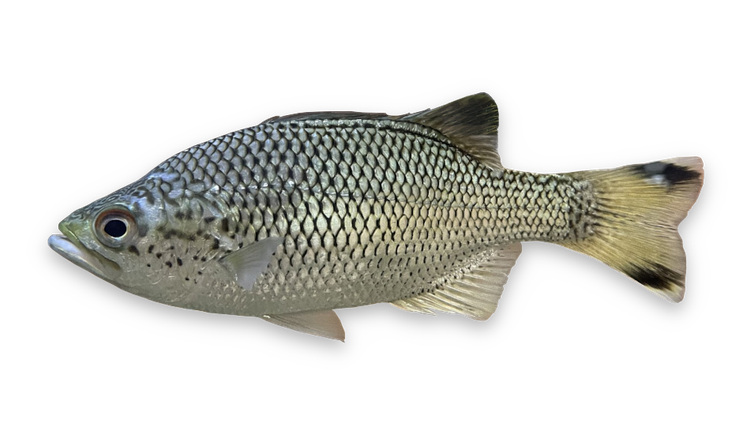
Kuhlia rupestris
Buffalo Bream, Mountain Trout, Rock Flagtail, Dusky-finned bulleye, Rockmountain bass, Spotted flagtail
Jungle perch have moderately deep, compressed bodies with a pointed head, an oblique, protractible mouth, and large eyes. Their dorsal fin is deeply notched, and the caudal fin has relatively rounded lobes and is emarginate. The species is brown to olive on its upper parts, silvery on the flanks, and white on the belly and breast. The flanks are adorned with dusky or reddish-brown spots, and each lobe of the caudal fin has a black blotch, which in older fish may fuse into a vertical bar. The scales are cycloid. Juveniles feature a broad black zone edged with white on the soft portion of the dorsal fin and black spots with white edges on each lobe of the caudal fin, which darkens with growth until most fins in adults become black, with whitish upper and lower edges and corners on the caudal fin. The specific name is from the Latin rupestris (= living among rocks, rock-dwelling), presumably about the freshwater habitat of this species.
Inhabits fast-flowing freshwater streams and rivers, usually in rainforest areas but also in estuaries and inshore coastal waters.
They occur from the Gulf of Carpentaria, Cape York, to Tallebudgera Creek, Queensland. Elsewhere, the species is widespread in the Indo-west-central Pacific, from the western Indian Ocean, north to Japan (Ryukyu Islands), south to Queensland, Australia and east to the Federated States of Micronesia (the Caroline Islands), Fiji and Samoa.
Omnivores - they feed on aquatic and terrestrial insects, crustaceans, small fishes, and fruits (such as figs) that fall from overhead trees. Primarily a freshwater species, with adults migrating downstream to spawn in estuaries or nearshore marine waters, from November to April.
Jungle perch are eagerly sought after by sports anglers. Not usually taken for the table, due to their seemingly small population and average size caught.
For jungle perch, use small hard-body subsurface lures, surface lures, or soft plastics ranging from 30 to 100 mm. Fly fishing can also be effective, but care must be taken not to spook the fish with the fly line. Using long leaders and making precise casts from behind the cover can improve success rates. It’s beneficial to "match the hatch" by using natural-coloured lures that resemble prey commonly found in the environment, such as black or green lures during a march fly or cicada hatch. Jungle perch often eat the lure and turn quickly, which typically hooks them without requiring a hard strike.