Common names
Large-toothed Flounder
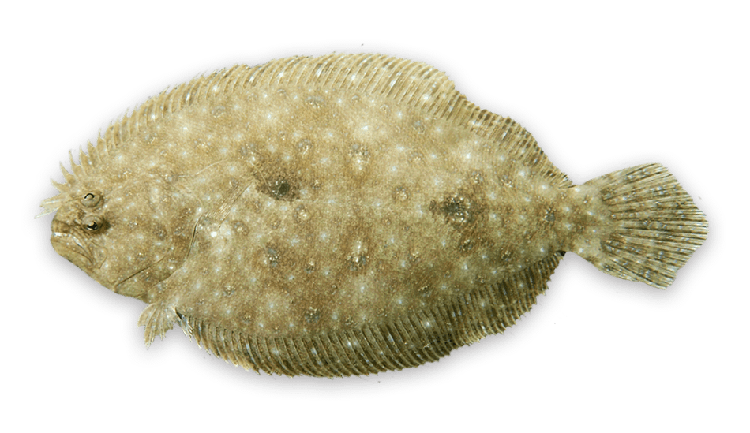
Pseudorhombus arsius
Large-toothed Flounder
Largetooth flounder have an oval-shaped body, the head has a slight notch in front of the upper eye. The eyes are bulbous and both on the left side. The body is greenish to pale brownish in colour and is normally marked with variously sized rings, and there are frequently two dark blotches on the straight and the curved sections of the lateral line with a smaller blotch which is halfway to the caudal-fin peduncle. It can vary the colour of the body so that it closely matches the surface the fish rests on. The dorsal fin starts in front of its upper eye and of the nostrils on the blind side. The mouth forms a deep cleft with the upper jaw normally almost half the length of the head. The upper jaw reaches below the posterior edge of the lower eye. There are several pairs of moderately large caniform teeth in the anterior parts of both jaws, which are of unequal size and arranged in a single row. The gill rakers are pointed, longer than they are broad. The tail fin is well separated from the dorsal and anal fins. t is best separated from other members of its genus by the presence of two dark spots placed centrally on its dorsal surface. The first is located just behind the pectoral fin, the second is halfway between the first spot and the tail fin.
Occurs in shallow waters and in estuaries where the substrate consists of mud and sand bottoms. The juveniles are common in brackish water.
Found in the tropical and temperate waters from the Persian Gulf and the eastern coast of Africa as far south as Algoa Bay and possibly even Knysna to Fiji in the western Pacific, to southern Japan in the north and as far south as the northern coast of Australia. It may extend as far south as the Bass Strait.
They are predators which prey mainly on benthic (bottom) animals. They lie on the bottom buried under the sand with only their eyes protruding. The spawning season runs for 3 to 4 months, from April to July and peaks in April and May, during which they move into the sandy shallows close to the shore and to deeper waters in the winter. The spawn is laid in a single batch.
Poor.
Bottom fishing from a drifting boat across the sand flats is productive, also trolling lures along the bottom can be successful. Largetooth flounder will take almost any bait. Good baits: worms, pipis, prawns, pilchards or fish strips.