Common names
Common coral trout, Leopard coral trout, Blue-dotted coral grouper, Spotted coral grouper, Leopard trout, Leopard cod
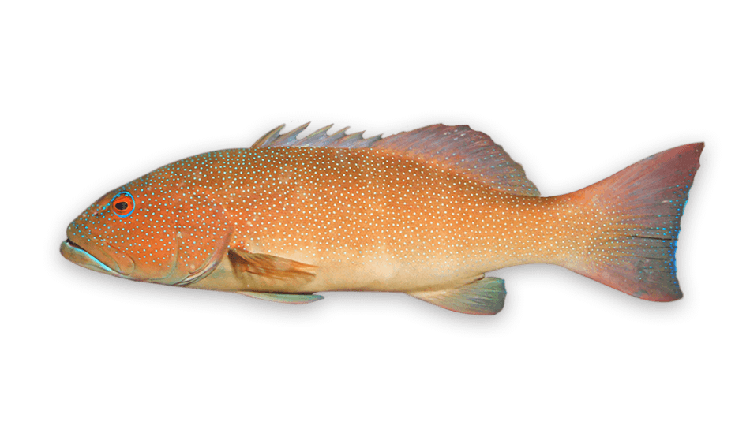
Plectropomus leopardus
Common coral trout, Leopard coral trout, Blue-dotted coral grouper, Spotted coral grouper, Leopard trout, Leopard cod
Leopard coral grouper have a body which is elongated and robust. The preopercle is mostly rounded, with three large, downward-pointing spines along the bottom half. The dorsal fin contains 7-8 spines and 10-12 soft rays while the anal fin contains 3 spines and 8 soft rays. The spiny part of the dorsal fin has a shorter base than the soft-rayed part. The caudal fin is a emarginate. The background colour is olive green to reddish brown or orange-red and its upper body is covered in regularly-spaced bright blue spots and there is a blue ring around the eye, this may be broken up. They are able to quickly change colour and frequently take on a mottled pattern as they hunt.
Inhabit coral-rich areas of lagoon reefs and mid-shelf reefs. Juveniles have a demersal existence in shallow water in reef habitats, especially around coral rubble.
Found in the western Pacific where it is distributed from southern Japan to Australia and from the east coast of Thailand and Malaysia east to the Solomon Islands, Caroline Islands and Fiji. In Australia it is found at Beacon Island in Western Australia, the Ashmore and Cartier Islands in the Timor Sea, around the tropical northcoast as far south as Sydney. This range includes reefs in the Coral Sea, Christmas Island, Cocos (Keeling) Islands and around Lord Howe Island in the Tasman Sea.
Largely piscivores (fish-eating predators). Juveniles mostly eat crustaceans, especially prawns, which live on or near the reef bottom. However, adults feed upon a variety of reef fish. The most common type of fish eaten is damselfish, particularly the spiny chromis damselfish. Adults also eat juveniles of their own species. Individuals or pairs usually swim slowly near schools of small fishes or rest on coral or on the bottom. They are inactive at night, hiding under ledges. They also change their sex from male to female during their life cycle.
A very popular fish, having firm, moist, pearly white flesh with a delicate sweet flavour. They are prized in Asian restaurants and commonly served whole to show off their impressive appearance. The cheek meat is considered by some to be the best bit.
Good performing lures are prawn imitations, large curly tail profiled soft plastics, diving minnow lures, and poppers, combining them with a heavy TT jighead, usually, a 1oz 6/0 or 1.5oz 7/0 is very effective. The relatively heavy head allows you to keep the lure in direct contact with the bottom where it needs to be. Good bait: fresh whole fish, squid, or pilchards.
Barcheek coral trout