Common names
Parore, Black bream, Blackfish
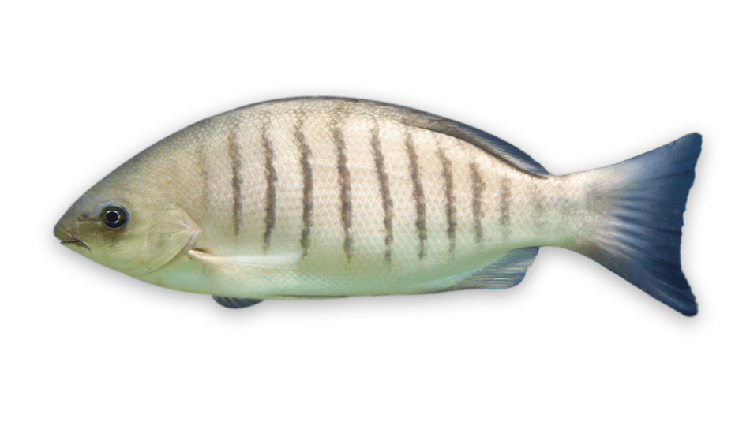
Girella tricuspidata
Parore, Black bream, Blackfish
Luderick are generally dark green/brown in colour with a silvery-grey belly. Luderick can be recognised by its evenly arched dorsal and ventral profiles, small mouth and eyes, large tail (broad and powerful), and colour pattern. In marine waters, it is bluish-grey, whereas in estuaries it is a darker grey to brown. The head and pectoral fins are sometimes yellowish in colour but the fins are usually the same colour as the part of the body they are nearest to. They possess 8-12 dark, narrow vertical bands across the back, and down the body, starting at the dorsal fin and dissipating towards the ventral area. Much of the body is covered in moderately small ctenoid scales and there is an arched lateral line which is parallel to the dorsal profile. It has a continuous dorsal fin which has no demarcation between its spiny and rayed parts. They have a smooth, round forehead and a set of teeth well adapted to a diet consisting predominantly of weed and to a minor degree small invertebrates.
Found in shallow coastal and estuarine waters where the frequently congregate in large schools in the vicinity of rocky outcrops and jetties.
Parore occur off eastern Australia and New Zealand. In Australia, they occur from Mackay, Queensland, to the east of Adelaide in South Australia and off most of Tasmania. In New Zealand it occurs on both the east and west coasts of the North Island from the North Cape to the Cook Strait.
They are mainly herbivorous, feeding on seagrass and green algae, and sometimes molluscs, prawns and polychaete worms.
Luderick have a moist, soft white flesh and a distinct flavour. Like bream, their environment will influence their flavour, with those caught in estuaries often muddier in flavour than those from open water.
Long, flexible rods, very small hooks and pencil floats are commonly used, with green weed the preferred bait. Most luderick are caught in winter. Good bait: Marine weeds (green weed and cabbage), bread, cunjevoi and marine worms.
Zebra fish (Girella zebra), however, they are rarely found in southern New South Wales and they possess wide stripes on the body (as wide as the gaps).