Common names
Mangrove jack, Grey snapper, Creek red bream, Stuart evader, Dog bream, Purple sea perch, Red bream, Red perch, Red reef bream, River roman
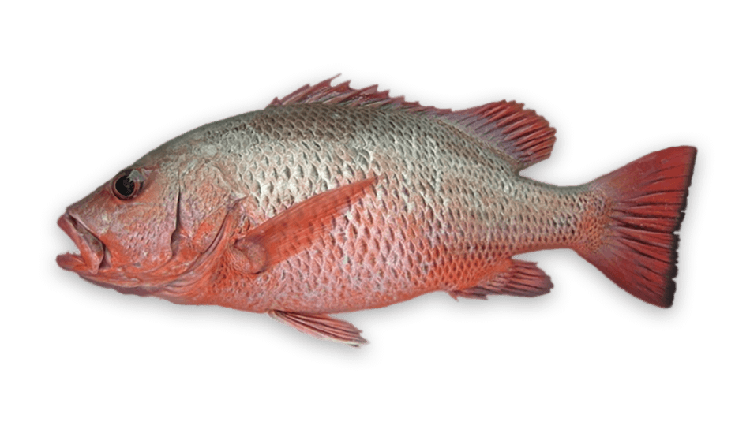
Lutjanus argentimaculatus
Mangrove jack, Grey snapper, Creek red bream, Stuart evader, Dog bream, Purple sea perch, Red bream, Red perch, Red reef bream, River roman
The colouration of mangrove red snapper ranges from burnt orange to copper, to bronze and dark reddish-brown, depending on its age and environment. Younger fish caught in estuarine areas are often darker than older fish taken from offshore reef areas and exhibit lighter vertical bands down their flanks. Fins have a pinkish hue, with the tail generally a darker shade. Each scale has a dark spot, which gives the appearance of cris-crossing lines on the body. Like other tropical snappers, mangrove jacks have prominent canine teeth in their jaws that are used for seizing and holding prey. These teeth can cause a nasty injury to unwary fishers. In reef areas, mangrove red snappers are sometimes confused with two-spot red snapper or red bass. The red bass, however, is usually darker in colouration, has fewer dorsal-fin spines, scale rows on the back that rise obliquely from the lateral line, and a deep groove from the nostrils to the eyes.
As its name implies, the mangrove red snapper is commonly found in mangrove-lined estuarine systems, although is known to migrate to offshore reefs to spawn.
Indo-West Pacific: East Africa to Samoa and the Line Islands, north to the Ryukyu Islands, south to Australia. Has dispersed into the eastern Mediterranean (off Lebanon) via the Suez Canal but not well established there.
The species is carnivorous, they are predators, feeding mainly at night on fish, crustaceans, gastropods, and cephalopod molluscs. As ambush predators, they often dwell around mangrove roots, fallen trees, rock walls, and any other snag areas where smaller prey reside for protection. As they mature, mangrove red snappers move into open waters, sometimes hundreds of kilometres from the coast to breed.
Mangrove Jacks are excellent for eating fish and reveal firm, sweet-tasting white flesh.
They love surface lures (splash prawns, suga pens, stick baits, paddle tail plastics & poppers), especially around dusk, and dawn and at night around pontoons, bridges, pillars, pylons, mangrove lines and rock bars and walls. Also takes the cast and trolled deep-diving lures. Good bait: mullet, yellowtail, herring, prawns, oily fish such as tuna.
Golden snapper, Red bass, Two-spot red snapper, Mangrove jack