Common names
Mayan cichlid, Atomic Sunfish, Mojarra Castarrica, Orange Tiger
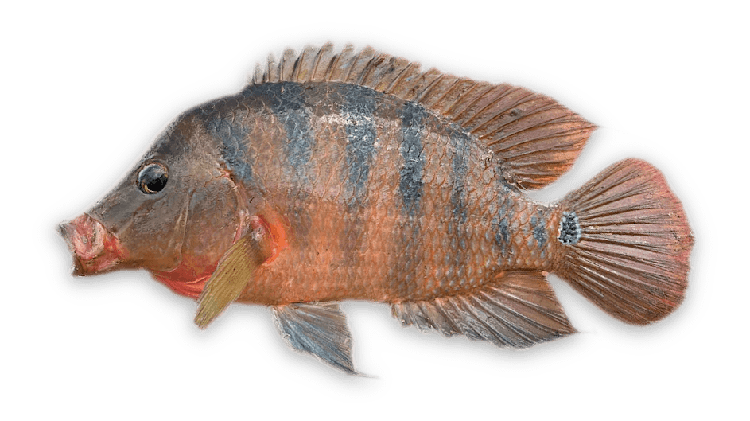
Mayaheros urophthalmus
Mayan cichlid, Atomic Sunfish, Mojarra Castarrica, Orange Tiger
Mexican mojarra are brackish water fish. Their body is oval and flattened on the sides and the head is tapering towards the mouth. Their fins are spiny and they have a base colour of yellow-brown to grey-brown in most cases, which becomes intense red during breeding. The head and throat are reddish, especially in younger fish. The caudal fin and the soft sections of the dorsal and anal fin are usually more or less reddish. Six wide green-black vertical stripes run across the sides of the body between the base of the pectoral fin and the base of the caudal fin. There is a large black eye spot circled with blue-green on the tail stem. Since the distribution area of the species is relatively large, this species may occur in different colours, which may differ from the one described above.
Inhabit freshwater marshes and mangrove swamps. Adults prefer coastal lagoons and rivers and will tolerate marine conditions.
Native to Central America: Atlantic drainages from Mexico to Nicaragua. Introduced to warm tropical waters of the United States, considered an invasive species in Florida.
The Mexican Mojarra is omnivorous. It primarily eats animals such as snails, insects, crustaceans, and smaller fish. Besides, they also eat plants, like algae and other plant matter. Their mating season is from spring to early summer. Spawn on the bottom in both fresh and brackish water. They're found in schools.
Excellent, it is said to have a subtle, delicate taste that isn't too strong or fishy with a high amount of nutrition.
Since they swim near the surface, they’re perfect for fly fishing. Successful flies used for the mexican mojarra are sponge spiders, cork poppers, and minnows. Good bait: shrimps, small minnows, worms, and even white bread.