Common names
Mangrove crab, Black crab, Samoan crab
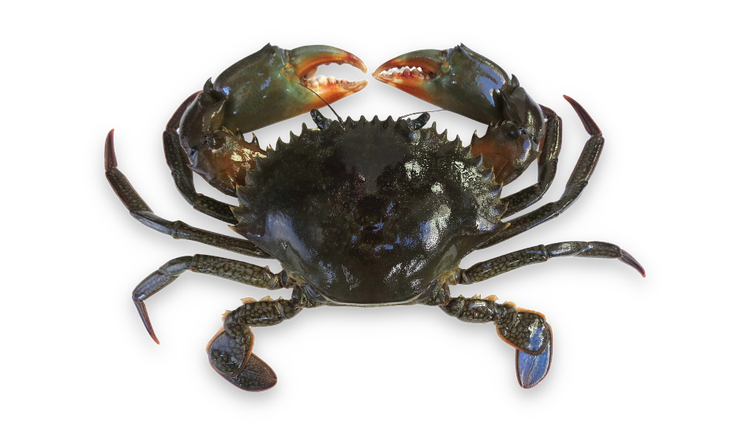
Scylla serrata
Mangrove crab, Black crab, Samoan crab
Mud crabs are large, powerful swimming crabs with a smooth, broad carapace and extremely strong claws designed for crushing and cutting prey. Their two rear legs are flattened and paddle-shaped, allowing them to swim efficiently. Coloration typically ranges from dark brown to mottled green, with shells often appearing deep green or almost black. The claws are massive, smooth, and noticeably longer than the other legs. The walking legs are thick and sturdy, with the fourth pair modified for swimming. Males have a narrow abdomen with fused segments, while females have a much broader, oval-shaped abdomen.
Mud crabs are closely associated with mangrove-lined coastal environments. They favor soft, muddy bottoms below the low-tide mark and are commonly found in sheltered estuaries, tidal mudflats, mangrove forests, and the lower reaches of rivers influenced by tides.
In Australia, mud crabs occur from Exmouth in Western Australia, across the Northern Territory and Queensland, and down the east coast to the Bega River in southern New South Wales. Globally, their natural range spans the Indo-Pacific, from South Africa and the Indian Ocean through Southeast Asia, southern Japan, and southeastern Australia, extending to northern New Zealand, Fiji, and Samoa. The species has also been introduced to Hawaii.
Juvenile mud crabs feed on planktonic animals as well as small mollusks and crustaceans. As adults, their diet shifts to larger prey such as mussels, pipis, small crabs, and marine worms. They prefer sheltered, muddy environments where they dig burrows using their sharp claws. These burrows serve as both protection from predators and a resting place. Mud crabs are mostly nocturnal, becoming far more active after dark.
Mud crabs are highly prized for their size and dense meat. The flesh has a rich, sweet flavor with a slightly briny taste, making it ideal for bold, well-seasoned dishes. Their robust texture holds up well to strong spices and sauces, earning them a top spot among seafood lovers.
Mud crabs are commonly caught using crab pots or traps baited with fish frames, meat, or other oily baits. Night-time is the most productive period, as mud crabs are most active after dark. Leaving traps overnight often yields the best results. Rainfall can increase crab activity, but during heavy rain it’s best to move traps into deeper water. In the wet season, focus on brackish coastal areas, while in the dry season, follow saltwater further upstream into rivers and creeks. Setting traps in deep gutters, small creeks, and positioning the entrance facing the current can significantly improve success. Good baits: Chicken carcasses, fish frames & whole mullet.