Common names
Mutton fish, King snapper, Ariocó, Caranho, vVirgin snapper
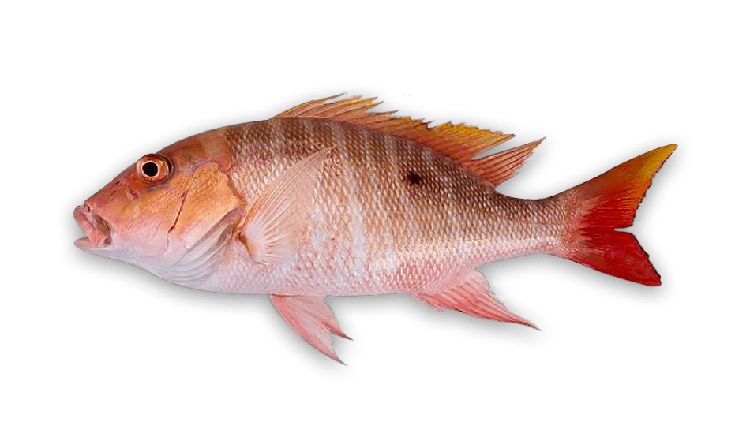
Lutjanus analis
Mutton fish, King snapper, Ariocó, Caranho, vVirgin snapper
Mutton snapper have a moderately deep, almond-shaped body, with a nearly lunate caudal fin. The dorsal fin is almost two-lobed and it has a sharply pointed anal fin. The pectoral fin is long, extending just past the origin of the anal fin. It has small eyes, a straight dorsal profile on the forehead and a comparatively large terminal mouth with a protrusible upper jaw which is mostly covered by the cheekbone when the mouth is closed. This is a colourful species with olive green on the back, red fins and upper flank shading to reddish the lower flanks and abdomen. There is a black spot between the lateral line and the spiny part of the dorsal fin. There is a pair of blue stripes beneath the eyes and the higher one continues on to the operculum. The caudal fin has a black margin. When the fish is resting it has 10 to 12 dark vertical bars on the body, these merge into a solid colour when the fish is swimming. Small juveniles have transparent fins and yellowish-brown bands on the body, larger juveniles are marked with yellow bands on their body and a more prominent black spot than the adults.
The larger adults live in and around offshore reefs and in areas of rock rubble, and the juveniles stay in inshore waters where they can be abundant in habitats such as tidal mangrove creeks, canals and shallow protected bays. The juveniles often shelter within turtle grass beds.
Native to the Atlantic coastal waters of the Americas from Massachusetts to southern Brazil, including the Caribbean Sea and the Gulf of Mexico. They are particularly common in the Caribbean.
Mutton snapper are a predatory species which change their diet during their life cycle. The larvae feed on plankton near the surface of the sea, when they settle to live in the turtle grass beds they eat larger items of plankton and small invertebrates. As they grow they begin to feed on crustaceans, gastropods and smaller fishes, like grunts and mullets. They feed throughout the day, picking at prey. The body colour changes depending on the method of feeding, the dark barred pattern being adopted when feeding near the bottom. They spawn in July and August.
Excellent, mutton snapper has a lean, firm texture. They have white pink-tinted flesh, and a mild, sweet taste when eaten fresh.
Mutton snapper have been caught on artificial baits, but seem to prefer live bait. Effective lures to use would be crawfish crankbait, minnow swimbaits, vertical spinners, jigging lures and tail spinners. Good bait: live pilchards, pinfish, small jacks, blue runners, cigar minnows, goggle eyes, speedos, and live ballyhoo; also dead fresh bait is effective.
Lane snapper, L. synagris (rounded anal fin)