Common names
Brown-spotted rockcod, Estuary cod, Estuary rockcod, Goldspotted rockcod, Greasy cod, North-west groper, Orange spotted cod, Blue-and-yellow grouper
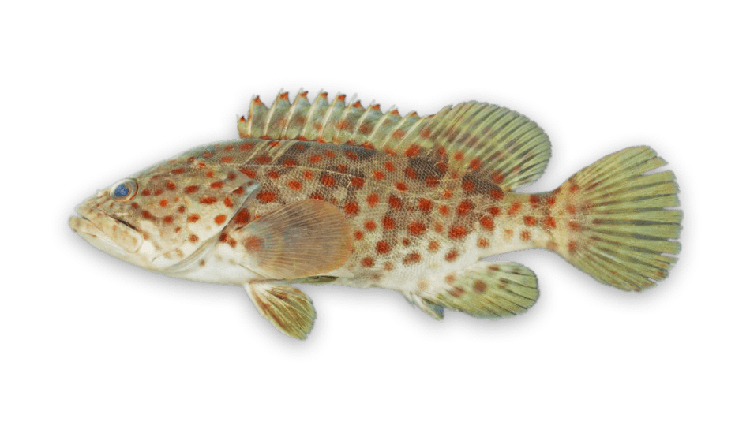
Epinephelus coioides
Brown-spotted rockcod, Estuary cod, Estuary rockcod, Goldspotted rockcod, Greasy cod, North-west groper, Orange spotted cod, Blue-and-yellow grouper
Orange-spotted grouper has an elongated body, the dorsal profile of the head is flat or slightly convex between the eyes, and the preopercle has enlarged serrations at its angle and a shallow notch just above the angle. The upper margin of the gill cover may be straight or slightly convex. The membranes between the dorsal fin spines are obviously incised. The caudal fin is rounded. The head and body are light brown on the back lightening to whitish on the underparts. There are four oblique "H-shaped" dark markings on the flanks and 3-4 dark saddle-like blotches along the back while the head, body and fins are covered in numerous small brown or orange spots. The spots are larger and less numerous in juveniles, shrinking in size and multiplying in number as the fish grows.
They occur in coral reefs, especially those along mainland coasts and large islands. The juveniles are frequently encountered in estuaries where there are sand, mud and gravel substrates and in mangroves.
Orange-spotted grouper have an Indo-Pacific distribution. They are found along the eastern coast of Africa which extends from the Gulf of Suez south as far as Durban in South Africa. They are also found off Madagascar, Mauritius, and Réunion and in the Persian Gulf eastward into the Pacific Ocean as far as Palau and Fiji. Their range extends north to Japan and south to Australia. In Australia, they occur from Carnarvon, Western Australia along the tropical northern coasts to the Solitary Islands in New South Wales.
They are a predatory species which prey on fishes, shrimp, crabs and other benthic crustaceans. At night these fish will at least partially bury themselves in the mud. They are diandric protogynous hermaphrodites, which means that some males develop from juveniles to males while others develop from functional females to males.
They are lean, and moist, with a distinctive yet mild flavour. It's got large flakes and a firm texture. They are known to be a famous local delicacy.
Artificial lures, especially diving ones, work well along shores and reefs for hunting groupers. A bottom feeder rig is typically used to fish for groupers. The rig must be adjusted so that the bait can sink to near the bottom. Good bait: fresh squid, baitfish, or prawns.