Common names
Tiger oscar, Velvet cichlid, Marble cichlid
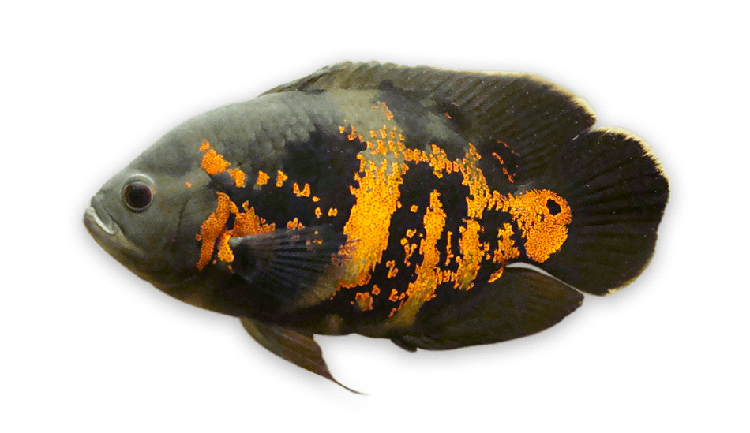
Astronotus ocellatus
Tiger oscar, Velvet cichlid, Marble cichlid
Oscar have an oval-shaped body, a large head, large eyes, and a large mouth. The first dorsal fin is spinous, and the second is composed of soft rays and has a rounded shape. The anal fin is spinous anteriorly and also possesses a rounded edge. Both the base of the soft dorsal and anal fins are scaled. Oscars are olive-green to grey to chocolate brown in base colour with a mottling of some or all of these colours. A large black spot surrounded by an orange ring present on either side of the base of the upper caudal peduncle is a striking characteristic of this species. These conspicuous “eye-spots” (some individuals may possess more than one per side) serve in an anti-predator capacity, causing confusion as to which end of the fish is the head. Young fish have wavy white and orange markings on a black background. All have a thick mucus coat on the body.
In their natural environment, the species typically occurs in slow-moving white-water habitats and has been observed sheltering under submerged branches. Most successful in canals running through marsh habitats, although found in lesser numbers in coastal canals, ponds, and lakes.
Native to Brazil, Colombia, Ecuador, Guyana, French Guiana, Suriname, Peru, and Venezuela, and occurs in the Amazon River basin, along the Amazon, Içá, Negro, Solimões, and Ucayali River systems, and also in the Approuague and Oyapock River drainages. Feral populations also occur in China, northern Australia, and the United States as a byproduct of the ornamental fish trade.
Spawning normally takes place on flat, solid surfaces when water temperatures warm, both parents are occasionally seen guarding hundreds of young in shallow water along shorelines. Feed primarily on crustaceans, gastropods, and aquatic insects or insect larvae. Although oscars are generally sluggish or inactive, they are capable of ambushing and capturing fleeing prey over short distances.
Good, white flaky meat with good flavour. Many people don't like to eat them because, in different countries, Oscar fish is mostly kept as a pet.
Best artificial baits include small jigs tipped with cut bait and small spinnerbaits, flyfishing with sinking flies is also productive. Good bait: cut fish, cut shrimp, crickets, and worms.