Common names
Red porgy, Bream, Pin perch, Sand perch, Butterfish, Sailor's choice
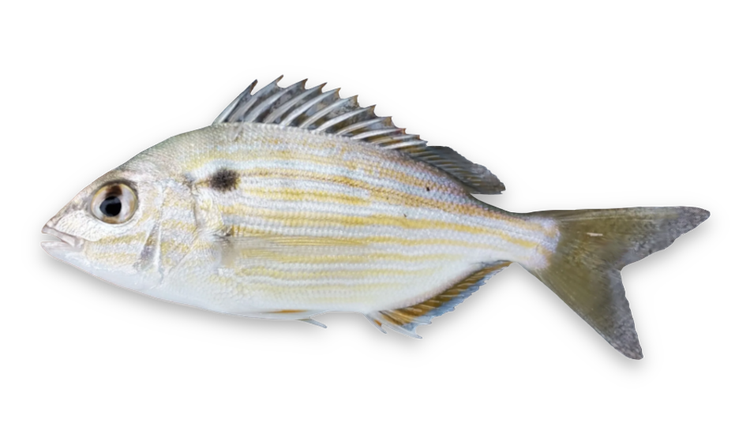
Lagodon rhomboides
Red porgy, Bream, Pin perch, Sand perch, Butterfish, Sailor's choice
Pinfish have a slightly oval, flattened body with a small mouth and relatively large eyes. Their head slopes steeply down to a pointed snout. The front teeth are small, sharp, and slightly stick outwards. Pinfish are olive-coloured on their back, fading into a bluish-silver along the sides, which are patterned with thin yellow and blue horizontal stripes and five or six faint vertical bars. Their fins are light yellow with pale blue edges, and they have a distinct black spot behind the gill cover.
Commonly found on vegetated bottoms (seagrass beds), occasionally over rocky bottoms, jetties, pilings and in mangrove areas. They enter brackish water and even freshwater.
Western Atlantic: Massachusetts (USA), Bermuda, and northern Gulf of Mexico to Florida Keys, USA and Yucatan, Mexico. Also on the northern coast of Cuba; absent in Bahamas or rest of Antilles.
Juvenile pinfish are carnivores, feeding mainly on shrimp, fish eggs, insect larvae, polychaete worms, and amphipods. As they grow older and larger, their diet shifts, with plant matter making up over 90% of their food once they reach over 4 inches (10 cm) in size. Often form large aggregations, especially where food items such as barnacles are abundant.
Pinfish have a decent flavour but are rarely eaten due to their small size and numerous tiny bones. Their taste is comparable to bream, but they are more commonly used as bait than as a meal.
Anglers use several methods to catch pinfish, including pinfish traps (chum placed over grassy bottoms), cast netting while chumming, and hook-and-line fishing. A light leader around 12# test works best. Use a tiny hair hook with a small split shot weight for the best results. A small dehooker is highly recommended to safely remove the fish, avoiding getting poked and keeping the bait healthier. Good bait: squid & shrimp (best), cut bait (for example, mullet), but just about anything will work.