Common names
Black drummer, Eastern rock blackfish, Black rockfish, Eastern rock blackfish drummer, Pig
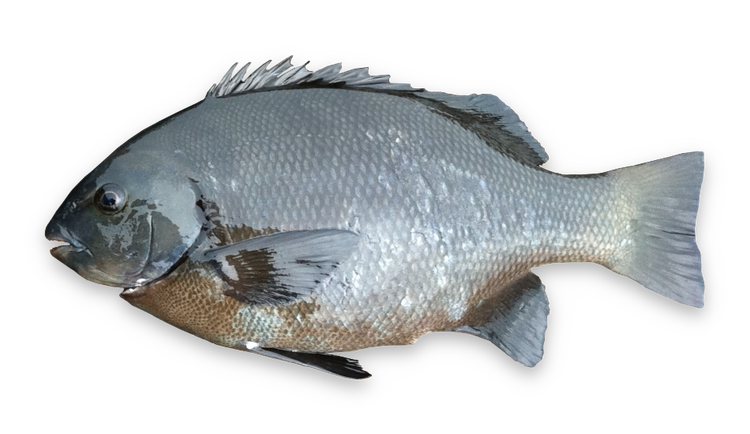
Girella elevata
Black drummer, Eastern rock blackfish, Black rockfish, Eastern rock blackfish drummer, Pig
Rock Blackfish have a moderately deep, compressed oval-shaped body with a small head and a slightly bulging forehead. They're covered with ctenoid scales, and their continuous lateral line arches parallel to the body’s dorsal profile. The dorsal fin is continuous, with the spiny part being about one-third longer than the rayed portion. The soft-rayed part of the dorsal fin is rounded. The anal fin mirrors the shape of the soft-rayed part of the dorsal fin and lies opposite it. They have a large, deeply forked caudal fin, small pectoral fins with the upper rays being the longest, and small pelvic fins located just behind the pectoral fins. Their body is uniformly blackish-brown to grey, with a black margin along the operculum’s posterior edge. Juveniles are more mottled, with dark colour broken by bands on the back.
Adults like rocky reefs and exposed situations, in caves or below ledges. Juveniles prefer more sheltered habitats such as seagrass beds, tidepools, and sheltered reef areas.
South-western Pacific Ocean in coastal eastern Australia and northern New Zealand. In Australia it occurs from Noosa Heads, Queensland south to Apollo Bay in Victoria and northern Tasmania, although it is rare west of Wilsons Promontory in Victoria. It is also found around Lord Howe Island in the Tasman Sea.
They're omnivorous and feed on a range of invertebrates and algae. They form large schools under piers and jetties and around rocky outcrops, and often shelters in caves, under ledges and around boulders during the day.
Mild flavour with no strong "fishy" taste, offering sweet, white, and flaky meat. Its flesh is white and translucent, with no unpleasant odours. The fish yields thick, firm, and white fillets.
The best times of day to fish for drummer are usually in the period approaching a high tide, and/or during low light periods such as dawn or dusk. Bait should be lightly weighted so it washes around in the white water as realistically as possible. The bait is not allowed to sink far enough down that it will not reach the drummers who often station themselves in overhangs and caves several meters/feet from the surface. Good bait: cunjevoi, peeled prawn (best), bread, sea cabbage.
Silver drummer