Common names
Flathead mullet, Striped mullet, Black mullet, Bully mullet, Common mullet, Grey mullet, Mullet
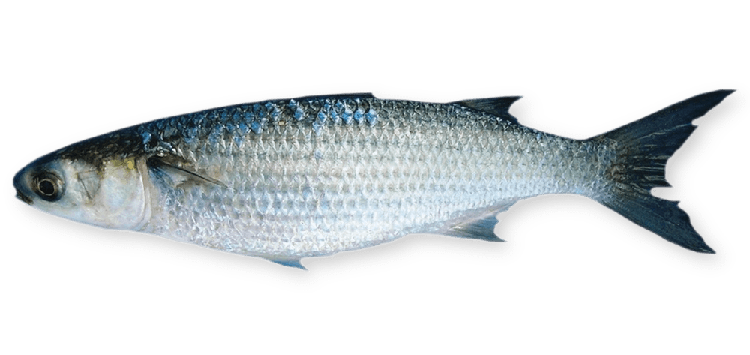
Mugil cephalus
Flathead mullet, Striped mullet, Black mullet, Bully mullet, Common mullet, Grey mullet, Mullet
Sea mullet have elongated, robust, moderately compressed, spindle-shaped bodies. Their head is small, dorsally broad and flat, the snout is short, the mouth is small, terminal, and oblique. They have a close-set row of slender mono-cuspid teeth on the edge of their lips and three or four rows of bicuspid teeth on the inner side of their lips. Their gill rakers are long and the lateral line is absent. Scales pavement is ctenoid, mucus canals straight, marked secondary squamation, no multi-canaliculate scales, they have enlarged axillary scales at the pectoral fin base and scales are absent from the head. They are variable in colour, depending on the habitat. Individuals in the ocean are bluish-grey on the back and upper sides, and silvery-white below. Sea mullet in estuarine areas are olive-brown with a pale belly. They may have six to seven distinctive lateral horizontal stripes. They can be distinguished from other mullets by the transparent gelatinous eyelid covering most of the eye.
They live in tropical and temperate coastal marine and estuarine waters, but are also often found in the lower reaches of rivers. They are able to live in a wide range of salinity and so may also be found in lagoons, lakes and far into estuaries.
Sea mullet is cosmopolitan in coastal waters of the tropical, subtropical and temperate zones of all seas, as far north as the Bay of Biscay and Nova Scotia in the Atlantic Ocean. In Australia, the fish is widespread, from Far North Queensland, around southern Australia to the Kimberley region of Western Australia. They also occur in the Bass Strait area of Tasmania.
Generally a bottom-feeding detritivore. Juveniles feed on zooplankton and benthic amphipods and copepods. The adult fish normally feed on algae in fresh water. The species is euryhaline, meaning that the fish can acclimate to different levels of salinity. Mature Sea mullet migrate along the coast or congregate in estuaries before moving offshore to spawn in surface waters over the continental shelf from February to September depending on location.
A strong, distinct taste and moist oily soft-medium textured flesh with few bones. The roe of mullet is considered a delicacy.
You can benefit from using a six-hook sabiki with hooks sized 4 to 8, lined with small shrimp. Anglers can also use hardlines or rods using rigs with floats. Can also be caught with fly fishing gear, anglers usually use tiny flies. One technique that anglers use when fishing for flathead grey mullet is to throw a few pieces of bread into the sea, particularly in calm waters or anywhere that has a lot of debris. Good baits: bread, peeled prawns, worms, or fish guts.