Common names
Shortfin eel, Silver eel, yellow eel, Southern shortfin
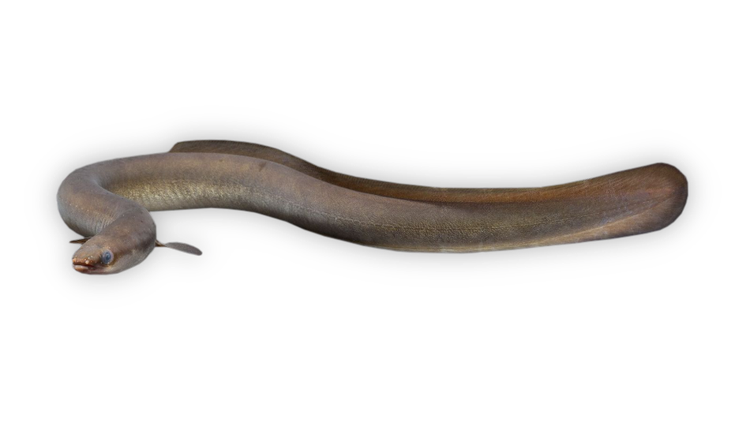
Anguilla australis
Shortfin eel, Silver eel, yellow eel, Southern shortfin
Short-finned eel have a long, roughly tubular (snakelike) body with dorsal, tail and anal fins forming one fin. They have small vertical gill openings on each side of the head, and large mouths extending to below the small eye. The dorsal fin begins just forward to the anal fin. The dorsal (top) and anal (bottom) fins are of roughly equal in length. The colour varies considerably from one individual to another. The back and sides may be olive-green or vary from pale green to olive-brown, but they can be much lighter, golden or even (rarely) yellowish, sometimes with coppery tints above and silvery sides. Belly is greyish to silvery-white. The fin colour is dark or greenish like the back.
Prefers low-lying swampy streams and lagoons, native to the lakes, dams and coastal rivers. Although it occurs in a wide variety of habitats it is essentially a still-water species.
South-eastern Australia, New Zealand, and much of the South Pacific, including New Caledonia, Norfolk Island, Lord Howe Island, Tahiti, and Fiji.
Adult eels are known to take fish of various types, worms, insects, small crustaceans, molluscs and water plants. Feeding appears to follow a seasonal pattern, being most intense at night in shoreline shallows during spring and summer. Spend most of their life cycle in freshwater and migrate downstream to spawn at sea when sexually mature.
Short-finned eel make excellent eating and have long been esteemed as an important food, but removing their skin is hard. The consumption of short-finned eels is a longstanding tradition in many Pacific nations.
A solid mid-range rod able to handle a 3 to 4-kg line with a reel to match is the way to go. You may prefer to use smaller hooks, such as a size 6 regular hook, also a baitholder hook can be effective because it allows your bait to wiggle, which adds more attraction. Good bait: scrubworms, garden worms, yabbies, bait fish, bardie grubs, and even sausage, liver, or other meats. (they aren't picky)