Common names
Gemfish, Silver kingfish, Southern kingfish
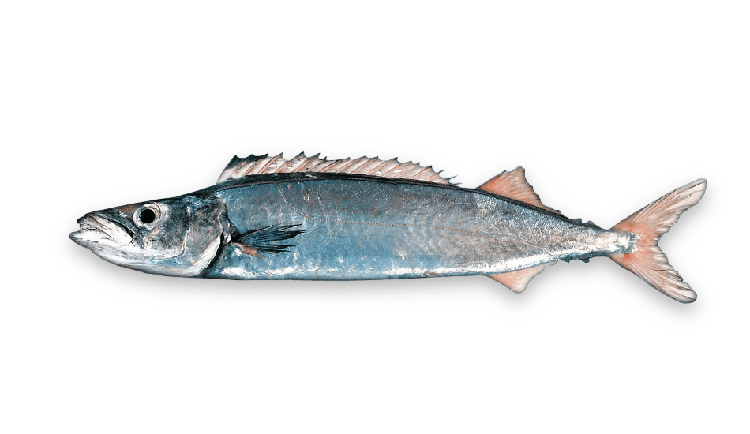
Rexea solandri
Gemfish, Silver kingfish, Southern kingfish
Silver gemfish are generally blueish above and silvery below, which darkens to a more bluish-to-purplish tinge after capture. The first dorsal fin has a large black blotch near the outer margin between the first three spines, the rest of the fin is greyish and the second dorsal, anal and caudal fins are all orange. Their body is long, slender and compressed. Their lower jaw is protruding and has a single pair of fang-like teeth. The lateral line is in two parts, bifurcating below the 5th to 6th spine of the first dorsal fin. The second dorsal and anal fins are followed by two finlets. Scales are present only on adult specimens.
They are bottom-dwelling fish which inhabit deep water. Juveniles are pelagic, adults also occur near the surface.
Found in the southwestern Pacific Ocean around Australia and New Zealand with reports of possible records from Madagascar and Japan. In Australia off New South Wales, Victoria, South Australia and Tasmanian coasts.
In southeastern Australia, spawning schools migrate each winter from Tasmanian waters to off the NSW and southern Qld coasts. They are carnivores, which feed on fish, squid and crustaceans.
Excellent, gemfish have white, delicate flesh that flakes easily. They are very versatile fish.
A fishing rod and reel with a strong line and appropriate tackle for gemfish are necessary. Jigs and soft plastic lures can be used to catch gemfish, especially in deeper waters, where live bait may not be readily available. Good baits: squid, sardines, pilchards, cut bait, oily fish such as tuna or mackerel.
Barracouta (Thyrsites atun)