Common names
Common snook, Sergeant fish, Robalo
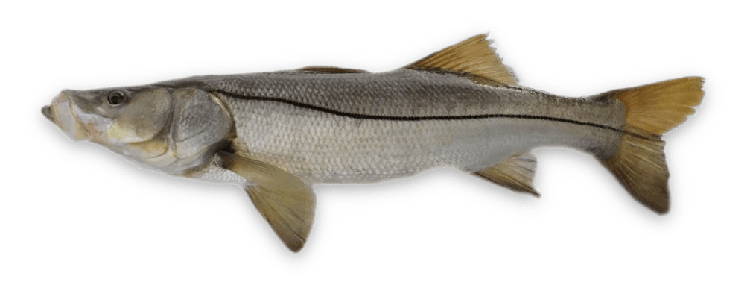
Centropomus undecimalis
Common snook, Sergeant fish, Robalo
Snook have a slender body, and long, concave snouts with jutting underjaws, which reach below the rear portion of the eye. The lateral line is pigmented in black and distinct, extending well into the tail. Colouration ranges from dark brown to dull grey with a yellow to green tint on the dorsal surface (back). The lateral surface (sides) tends to be silvery, and the ventral surface (belly) is generally white. The pectoral fins, pelvic fins, second dorsal fin, and the dorsal lobe of the caudal fin are all bright yellow in colour, however, some specimens are considerably darker. The two dorsal fins are high and well-separated, and the anal spines are relatively short. They have sloping foreheads.
Inshore in coastal waters, including mangrove shorelines, seagrass beds, beaches, estuaries, lagoons and around structures. They often enter freshwater.
Western Atlantic: from North Carolina, including the Gulf of Mexico, most of the Antilles and Caribbean coast of Central and South America extending southward to Rio de Janeiro, Brazil.
Snook are able to determine when to start and stop spawning based on the temperature and salinity of the water they inhabit, the amount of rainfall in the area, and whether or not the moon is full. They are opportunistic predators whose feeding habits indicate a positive relationship between their size and the size of their prey, meaning that as the snook grows, it feeds on larger and larger prey. They form schools during the spawning season. Their diet consists of fish and large crustaceans. Have been found to occasionally engage in cannibalism. They are hermaphrodites, which means that they change from male to female as they mature.
Snook, with their firm, white, and solid flesh, are mild-tasting table fish. They are one of the most delicious fish due to their diet of crustaceans and smaller fish.
Effective lures for snook are 3-inch and 5-inch white paddle tails with a 1/8-ounce jig head in shallow water and a 1 1/2-ounce flair hawk jig for deeper water fishing scenarios. An effective method is also free-lining live bait (for example, sardines). Good bait: live pinfish, small mullet, shrimp, or sardines.
Other Snook species