Common names
Black-finned half-beak, Dusky garfish, Dusky sea garfish, Gardie, Garfish, Pencils, Sea garfish, Sea gar-fish, South Australian garfish, Southern sea garfish, Western sea garfish
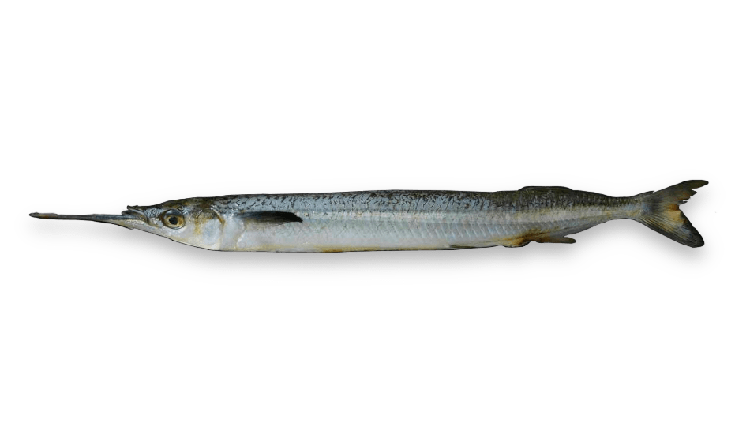
Hyporhamphus melanochir
Black-finned half-beak, Dusky garfish, Dusky sea garfish, Gardie, Garfish, Pencils, Sea garfish, Sea gar-fish, South Australian garfish, Southern sea garfish, Western sea garfish
The garfish displays a pale greenish hue, transitioning to bluish-green along its back, accentuated by a broad silvery stripe running along the midsection. This stripe is flanked by a blue line extending from behind the head to the tail. The garfish exhibits a white or silver belly, with a distinctive reddish tip on its lower jaw and a dusky margin on the caudal fin. Notable features include its elongated lower jaw, resembling a slender bill, contrasting with its short upper jaw. Their body is exceptionally long, slender, and rounded, covered in small scales. The fins may appear translucent or tinged with green. The dorsal and anal fins are short-based near the tail, with the lower lobe of the tail fin extending longer than the upper.
Pelagic near eel-grass beds in estuaries, rivers and coastal lakes.
Eastern Indian Ocean: Endemic to Australian temperate waters (Eden, New South Wales (and possibly further north), to at least Perth, Western Australia, including Tasmania). Also found in New Zealand waters.
They feed on invertebrates and plant matter in nearshore surface waters. Adults consume seagrass leaves during the day, and feed on planktonic crustaceans at night, along with insects taken from the surface of the water.
Garfish are excellent eating providing the time is taken to properly remove the numerous small bones. The flesh is translucent when raw and cooks white. It has a delicate, sweet flavour and medium oil content.
Most anglers find using a float and a swivel produces more successful results. Berley can be used to ensure that a school of fish remains near the fisher. They will occasionally take a small fly. The key is to keep the bait small, with 1cm in all dimensions a good starting size. If they’re in an aggressive mood you can catch them on small soft plastics (using a pair of scissors to trim down your soft plastics can help a lot). Good bait: prawns, sandworms, fish flesh and raw chicken, as well as raw maggots, dough and bread, pinched onto the hook.
Other garfish