Common names
Spotted bonytongue, Spotted saratoga, Simply saratoga, Australian arowana
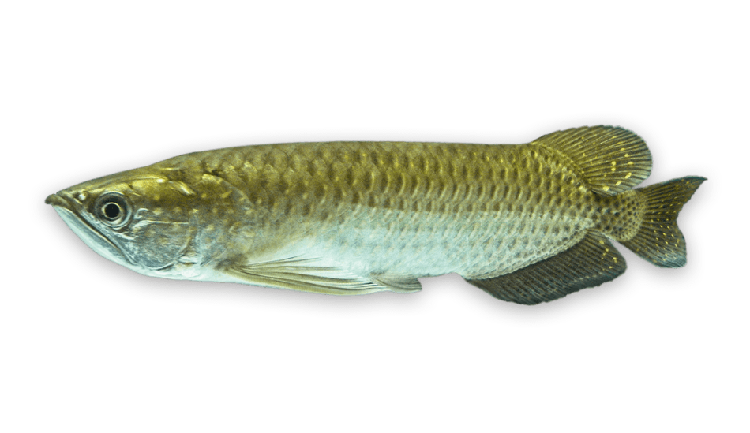
Scleropages leichardti
Spotted bonytongue, Spotted saratoga, Simply saratoga, Australian arowana
Southern saratoga have strongly compressed and moderately deep bodies. They have an almost perfectly flat back, with a dorsal fin set back towards the tail of their long bodies. The lower jaw slopes steeply upwards and carries two fleshy barbels on the chin. Their head is scaleless. They have thick, bony scales with canals which form a mosaic-like pattern covering the body. Their mouth is dorsally orientated, steeply sloping and extending back to the rear margin of the eye. They are dark brown to olive green along the back, with lighter sides and a white belly. The large, bony scales have small orange or red dots. Their fins are dark grey with a blackish edge and speckled with small pink spots.
Southern saratoga prefer still waters and slow-flowing sections of rivers and can be found sheltering in lily pads or below fallen timber. Often near the surface or near shore among aquatic vegetation.
Southern saratoga are native to the Fitzroy River system. They are commonly found in freshwater impoundments on the Mary, Dawson and Burnett rivers. Stocks have also been introduced to dams on the Brisbane, North Pine and Noosa Rivers.
They are very aggressive and territorial fish. Opportunistic carnivores, feeding on aquatic and terrestrial insects, small fishes and crustaceans. Spawning by direct pairing after a prolonged courtship, generally from September to early November.
Saratoga are very boney and not good table fare at all.
Topwater lures, poppers, stick baits and frogs all work well. For subsurface lures try hard bodies, spinnerbaits and plastics. It is also a great fish to target with surface flies, tough baitfish flies and flies with plenty of movement all work well (anything with a rabbit-fur tail works exceptionally well if it gives a life-like movement). Good bait: small fish, freshwater shrimp, freshwater yabbies and insects. (also have an appetite for human foods like, cheese, salami, cooked chicken skin, etc.)