Common names
Rock lobster, Langusta, Langouste, Crayfish, Sea crayfish, Crawfish, Kreef
Palinuridae
Rock lobster, Langusta, Langouste, Crayfish, Sea crayfish, Crawfish, Kreef
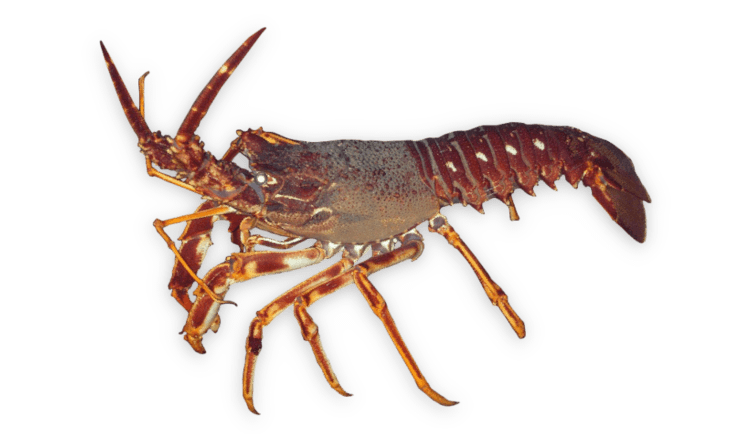
Spiny lobsters earned their name from the prominent spines covering their bodies, offering protection against predators. They have a reddish-brown shell, adorned with occasional dark spots. Long, horn-like antennae extend over their eyes, serving as a deterrent to potential threats, while smaller antennae-like "antennules" detect movement and chemicals in the water. Unlike true lobsters, spiny lobsters feature a slightly flattened carapace without any lateral ridges. Despite resembling true lobsters in some aspects, they are not closely related. One notable difference is the spiny lobsters' long, thick antennae and the absence of claws on their first four pairs of walking legs, though females may have a small claw on the fifth pair. In contrast, true lobsters possess smaller antennae and claws on the first three pairs of legs, with the first pair being notably enlarged.
Spiny lobsters tend to live in crevices of rocks and coral reefs (generally around rocky structures), only occasionally venturing out at night.
Spiny lobsters are found in almost all warm seas around the world, including the Caribbean and the Mediterranean Sea, but are particularly common in Australasia.
Spiny lobsters undergo growth through moulting, shedding their old shells while absorbing water to expand their body size. While young spiny lobsters primarily feed on soft-bodied plankton, juveniles and adults transition to a carnivorous diet, preying on various marine creatures like snails, clams, and sea urchins. They exhibit nocturnal behaviour, seeking refuge in coral reefs, burrows, or dens during the day and actively foraging for food at night. At times, they migrate in large groups, forming lengthy lines of over 50 lobsters across the sea floor. Their navigation relies heavily on detecting changes in natural substances' smell and taste present in different oceanic regions. Recent research suggests that healthy lobsters tend to distance themselves from infected individuals, allowing diseased lobsters to cope on their own.
The Spiny Lobster has a sweeter flavour profile than its counterpart, the Maine Lobster. It also has more meat — generally around 25% more per pound. They are harvested for their tail meat. Items marketed as “lobster tail” are usually from spiny lobsters, which are an all-time favourite for seafood lovers.
When you're under the water and come across a lobster hiding in a rock, have your net in place and use your tickle stick to go behind the lobster and “tickle” them out. Otherwise, baited hoopnets are the most popular method for lobster fishing. To hold the bait in the net use a heavy-duty nylon bait bag or metal/plastic bait cages. When lobster fishing you also need a variety of other gear, including a lobster gauge (double check with a micrometer to ensure it measures 3.25 inches), pulling gloves and a waterproof LED flashlight or headlamp. Good bait: chunks of bonito, skipjack, cut mackerel, dead sardines, mashed fish.
Furry lobster, Slipper lobster