Striped searobin
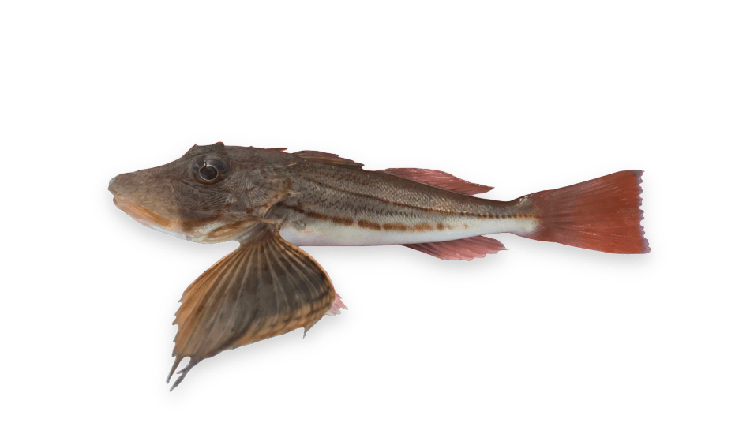
Prionotus evolans
- Saltwater
- Least concern
Max length17.75 in
Common length11.75 in
Length typeTotal Length
Max weight3 lb 8 oz
Depth range30 - 591 ft
Water typeSaltwater
Fish info
Short description
Striped searobin are red-brown to grey with a distinct stripe on each side of the body and a white underbelly. The large wing-like pectoral fins have a single broad blotch (the whole of the pectoral fin is marked with closely set, sinuous dark vertical lines with the inner part of the fin forming a dark patch). Striped searobin may have the most beautiful eyes of any fish, they resemble gemstones circled by gold. The lower rays of the Striped searobin's pectoral fins look like fingers and are used to "walk" along the bottom when searching for food. Their mouth is large, extending as far as the anterior margin of the eye and is slightly inferior with the lower jaw not protruding. There are two separate dorsal fins, the pectoral fin has a rounded posterior margin and the fin extends almost as far as the rear of the base of the anal fin.
Habitat
They inhabit sandy substrates from estuaries to offshore depths, infrequently being found associated with reefs.
Distribution
Western Atlantic Ocean where it is found from Nova Scotia in the north-south along the Atlantic coast of the United States to southeastern Florida, it is also found around Bermuda, striped sea robins are rare north of Cape Cod, Massachusetts.
Behaviour
Searobins can cluck, bark, and growl. Science hasn’t proven any behavioural context associated with these sounds just yet. Still, they observed that when a searobin does its staccato call, it is more likely associated with its reproductive behaviour. Striped searobin feed on crustaceans (like clams, shrimps, and crabs), cephalopods, gastropods, bivalves, amphipods, eggs, other fish and seaweed.
Edibility
Sea robins are edible subtle-flavoured, somewhat similar to fluke, flounder, and whiting, but with a firmer texture.
Lure suggestion
The most effective fishing method is bottom fishing (other popular methods also include bait casting and still fishing). Striped searobin follow and fall for baits on bottom rigs, but will take soft plastics as well. Good bait: bloodworms, clams, squid, or peeler crabs.
Similar species
Other similar species
Northern searobin, Lumptail searobin, Blue spotted searobin