Common names
Goldlined seabream, Silver bream, Yellowfin bream
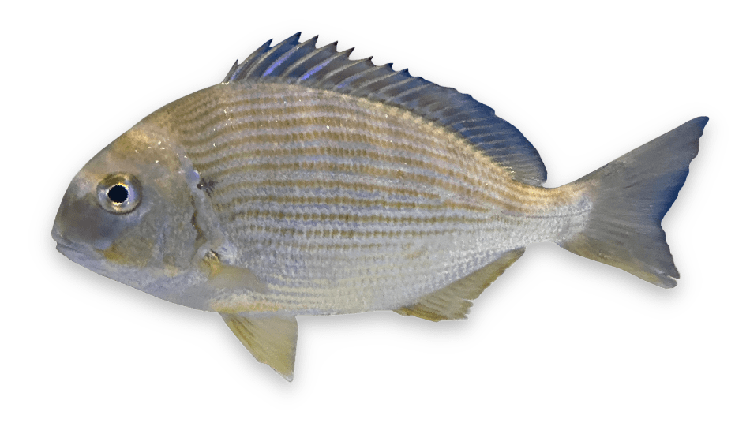
Rhabdosargus sarba
Goldlined seabream, Silver bream, Yellowfin bream
The fish boasts a greyish body with a silvery-gold sheen, while the underside shines in silvery-white. Delicate yellowish to golden stripes grace its sides, enhancing its visual appeal. Pelvic and anal fins carry a warm hue, ranging from yellowish to brownish-yellow. The body shape is oblong, moderately deep, and compressed, with a notably large head. The upper profile of the head is gently arched, most pronounced from the snout to the origin of the dorsal fin. The fish's eye is moderate to small, particularly in larger specimens, and its mouth sits almost horizontally, appearing low. Pelvic fins do not extend to the anus, and the caudal fin is distinctly forked. A vibrant yellow mark adorns the area above the pelvic base, adding to its distinct features.
Inhabit coastal waters, usually entering estuaries. Abundant in shallow water and often caught at the surf-line or in rock pools. Larger, solitary fish sometimes enter brackish mangrove areas.
Australia, from Bremer Bay to Exmouth Gulf, WA, and from Townsville, QLD to Mallacoota, VIC. Elsewhere the species is widespread in the Indo-West Pacific, from the Red Sea and the Persian Gulf to South Africa, eastwards to the South China Sea and Japan, and southwards to eastern and western Australia.
Spawning takes place near river mouths, after a short planktonic period, the young fish move into the estuaries, which act as nurseries, and move out into deeper waters with growth. They can change sex from male to female. They're often in schools & feed on bottom invertebrates, mainly molluscs.
Has a mild, sweet flavour, low oiliness and moist, medium-textured flesh. Some fish can have a slightly 'weedy' taste due to their estuarine and coastal habitat.
Always fish as light as possible for tarwhine this includes sinkers, lines and leaders. Hard-bodied, subsurface and soft plastic lures from 50mm – 100mm long will temp big tarwhine into striking. Good bait: Fresh or live river prawns, blood worms, muscles and small bait fish such as mullet.