Common names
Yellow pike, Yellow walleye, Walleyed pike, Yellow pikeperch, Yellow pickerel
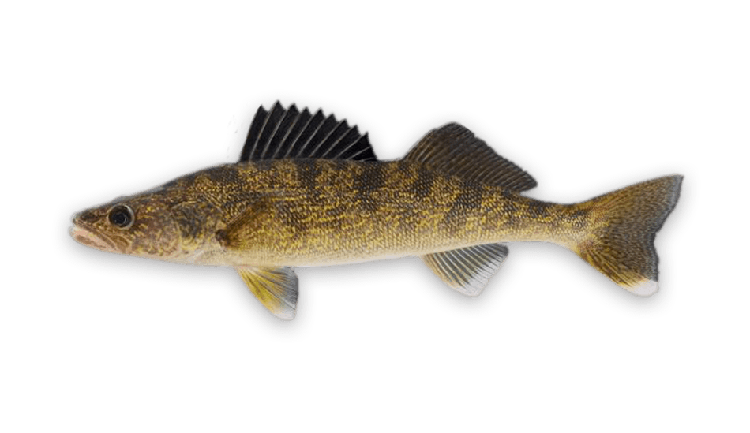
Sander vitreus
Yellow pike, Yellow walleye, Walleyed pike, Yellow pikeperch, Yellow pickerel
Walleye are largely olive and gold in colour. The dorsal side of a walleye is olive, grading into a golden hue on the flanks. The olive/gold pattern is broken up by five darker saddles that extend to the upper sides. The colour shades white on the belly. The mouth of a walleye is large and is armed with many sharp teeth. The first dorsal and anal fins are spinous, as is the operculum. The name "walleye" comes from their pearlescent reflective eyes, which in addition allow the fish to see well in low-light conditions. Walleye are distinguished from their close relative the sauger by the white colouration on the lower lobe of the caudal fin, which is absent on the sauger. In addition, the two dorsals and the caudal fin of the sauger are marked with distinctive rows of black dots which are absent from or indistinct on the same fins of walleye.
They are freshwater fish that live in rivers, natural lakes and reservoirs. They prefer cooler water temperatures found in both clear and turbid, shallow or deep water. Their vision also allows the fish to populate the deeper regions in a lake, and they can often be found in deeper water, particularly during the warmest part of the summer and at night.
North America: St. Lawrence-Great Lakes, Arctic, and Mississippi River basins from Quebec to Northwest Territories in Canada, and south to Alabama and Arkansas in the USA. Widely introduced elsewhere in the USA, including Atlantic and Pacific drainages.
Walleye are greedy predators. They avoid bright light and feed in low light on fish that cannot see as well as they do. They eat small bass, trout, pike, perch and sunfish. Prime feeding times are early morning and evening. The fish's eyes also allow them to see well in turbid waters (stained or rough, breaking waters), which gives them an advantage over their prey. Adults migrate to tributary streams in late winter or early spring to lay eggs over gravel and rock, although open-water reef or shoal-spawning strains are seen, as well. Some populations are known to spawn on sand or vegetation.
They have a subtle, sweet flavour with low levels of fishiness. Their thick fillets aren't too bony, and their texture is firm yet delicate and moist. They are also some of the healthiest foods available.
Popular lures to use are crankbait, grubs, paddle tails, and ring worms. Grubs on a jig, are the most popular alternative to live bait. Good bait: minnows, leeches, and worms.