Common names
Perch, Striped perch, American perch, American river perch, Preacher
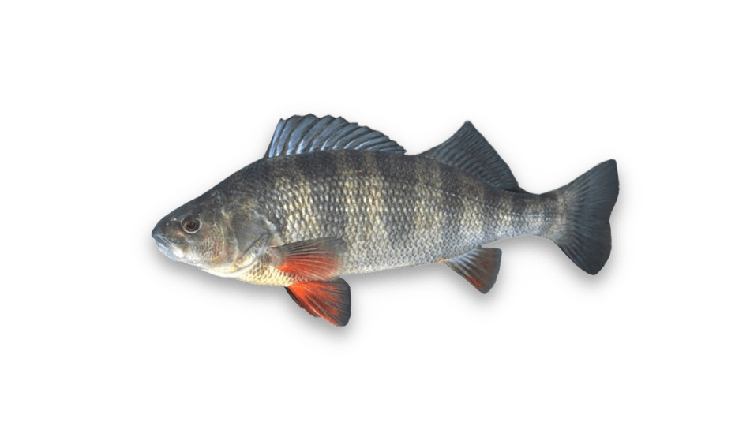
Perca flavescens
Perch, Striped perch, American perch, American river perch, Preacher
Yellow perch have an elongated, oval body with a relatively long but blunt snout which does not reach past the tip of the lower jaw. They have two separate dorsal fins. The upper part of the head and body varies in colour from bright green through to olive or golden brown. The colour on the upper body extends onto the flanks where it creates a pattern of 6–8 vertical bars over a background of yellow or yellowish green. They normally show a blackish blotch on the membrane of the first dorsal fin between the rearmost 3 or 4 spines. The colour of the dorsal and caudal fins varies from yellow to green while the anal and pelvic fins may be yellow through to silvery white; in spawning season, males develop pronounced red or yellow colour on their lower fins. The pectoral fins are transparent and amber in colour. The ventral part of the body is white or yellow. The juvenile fish are paler and can have an almost whitish background colour.
Yellow perch are commonly found in the littoral zones of both large and small lakes, but also inhabit slow-moving rivers and streams, brackish waters, and ponds. Due to human intervention, they are currently found in many man-made lakes, reservoirs, and river impoundments.
North America: Atlantic, Arctic, Great Lakes, and Mississippi River basins from Nova Scotia to Mackenzie River drainage, Northwest Territories in Canada, and south to Ohio, Illinois and Nebraska in the USA; south in Atlantic drainages to Savannah River in Georgia, USA. The yellow perch has also been widely introduced for sport and commercial fishing purposes.
Feed on immature insects, larger invertebrates, fishes and fish eggs during the day. Spawn between February and July in the northern hemisphere.
Very good, the lean meat is white, with a mild, sweet flavour and firm but flaky texture.
Perch at times attack lures normally used for bass such a 3" tubes, minnows, larger curl tail grubs on jigheads, and small, brightly coloured casting spoons, but the simplest way to catch them is to use light line, 4 to 8# test and light, unpainted jig heads, 1/32–1/16 oz. Good bait: minnows, mealworms, crayfish. or nightcrawlers.